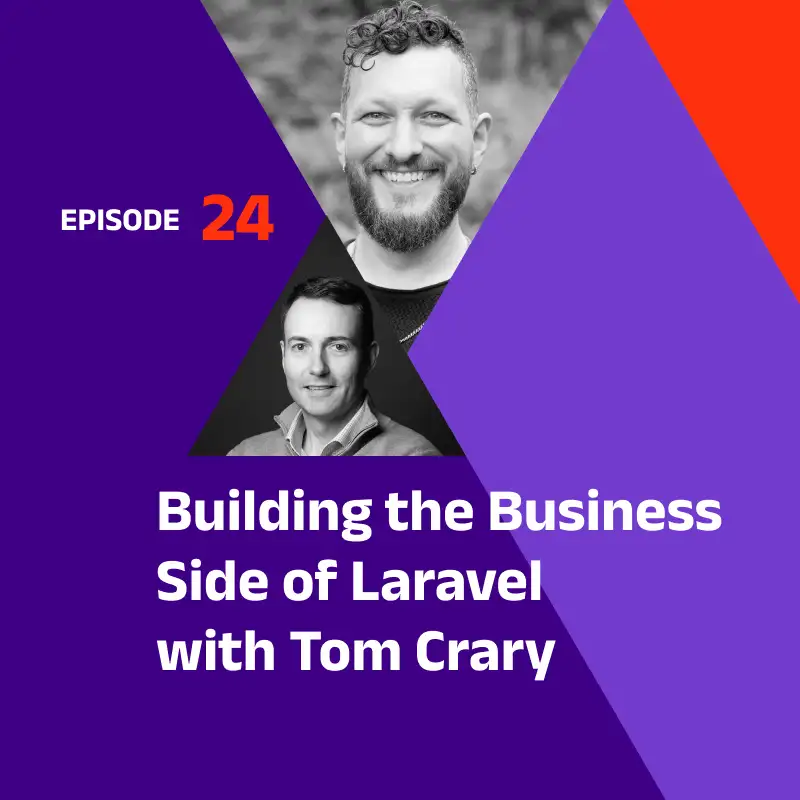
Building the Business Side of Laravel with Tom Crary
Hey, and welcome back to Laravel Podcast season seven. I'm your host, Stauffer, CEO at Tighten. And in this season, I'm joined every episode by a member of the Laravel team. And today, I'm talking to my friend, Tom Crary, president and COO at Laravel. I mean, we know that Taylor's big man on campus, but, I mean, you guys are I think you guys are kinda co big man at this point.
Matt Stauffer:So, Tom, it is a pleasure to have you. Can you kinda say hi and tell everybody what you do at Laravel?
Tom Crary:Thanks for having me, Matt. Exciting to be here. Yeah. No. I'm a little bit more behind the scenes than Taylor is, but that's okay.
Tom Crary:Mhmm. I am yeah. As you said, I'm president and COO here at Laravel. Excited to join the show.
Matt Stauffer:Okay. Yeah. Thank you for coming. So I wanna talk I kinda told you about this ahead of time. But before we talk about what you're doing right now and what you're doing looking forward, I wanna talk about who you were before Laravel.
Matt Stauffer:So what you know you know, one of the first things I asked the beginning is what's the story of you coming to work at Laravel? But I I wanna start way before then. It's like, what's the story of Tom Crary becoming the person that he is today? Like, where what's your
Tom Crary:background It's going deep. I wanna go to childcare. Yeah. I'll go I'll start at my career. I'll start my career.
Tom Crary:So So I came out of college and I was an accountant. So I started out working with technology companies at age 22, working for a big four CPA firm called KPMG. And so I came up to the finance ranks first couple of years working as an accountant and doing like public company technology company audits. Did that for like two and a half, three years, and I absolutely hated it.
Matt Stauffer:Were you just kind of like a cog at that point?
Tom Crary:No, actually, I mean, I shouldn't say I hated it. I hated parts of it. I really enjoyed working with the companies, working with the technology companies and working with senior leaders at a technology company, CFOs and CEOs and controllers and people like that that were obviously ten, fifteen, twenty years ahead in their career. And I'm sitting across the table from them really working through their business challenges. But I also hated that there was this framing of like auditing.
Tom Crary:Like it was all like controls and testing of the controls and stuff like that, that I just found like monotonous and they didn't wanna be there either. So it was cool to have the exposure to great businesses and senior leaders, but the actual stuff we were talking about didn't interest me. So it was like a good way to start. And I did that for two and a three years. And I remember there was some friends that I had that I used to work with and they started talking to me about a different side of accounting and finance on the investing side.
Tom Crary:So I quickly moved about three years in into the consulting world. So I became a financial consultant and I was working with same technology companies, but helping them do M and A. So helping companies by other companies. And actually during this time, I started working with some investors. So some private equity firms, some venture capital firms, things like that.
Tom Crary:And one of my clients actually was Excel Partners. So that's actually a little bit of a skip ahead to the end story. But I was working with Excel, this is now almost twenty years ago, seventeen or eighteen years ago, I'm working with them as a young financial consultant and helping them invest in the early stages of their growth technology investments. So at the time they invested in like Braintree, Squarespace, Atlassian to name just a few really great outcomes. There were some other not so good ones But in there I just found that work really, really entertaining and really interesting.
Tom Crary:So that got me interested in like being on the investing side and the strategy side of running companies. Well, anyway, I did that for a couple of years and that was really fun work, I really wanna get in the operations side of the business. So I left there, I left the consulting world and took my first CFO role at a solar technology company. So like rooftop solar, and it was like an MIT spinout that built a new form of rooftop solar. And it was pretty much pre revenue at this point.
Tom Crary:We were building the company from ground up, mostly a science based thing, like material science and physicists and chemists and all these PhDs from MIT that were trying to figure out really hard technology problems from that perspective. And my job was on the business side. I was the only finance person and I was raising money from venture capitalists. I was doing big partnership deals with companies from all over the world. I was doing global site selection for manufacturing plants, know, stuff like that.
Tom Crary:And in the course of which I met one president and several governors of multiple states around The US. It's really interesting interesting work. And maybe to tie it back to how I ended up back with Excel, I was out raising money for that company out in California. And I met up with my old friends from Excel who I worked with five, six years before, and they had no interest in investing in my company, but they started pitching me out another CFO role. And it was actually at the company ended up at before Laravel, was a company called Pond5, a digital media And e commerce I was the CFO there for several years from, let's see, about 2014 to 2020, had a great experience.
Tom Crary:It was a pretty small company when we got there, a $10,000,000 company. By the time we sold it in 2022, it got to about $60,000,000 So we grew up pretty nicely over that time. And along that course of that time, we had our struggles like all companies do. And in 2020, I became the CEO there. So from 2020 to 2023, I was the CEO of that company.
Tom Crary:And during that time, we sold it to a larger public company called Shutterstock. So that's when I exited working with Excel, became part of Shutterstock. I spent about a year and a half on the exec team at Shutterstock, running Pond5, getting involved in the Shutterstock strategy. And it kind of ran its course. I was ready to think of go back to smaller companies and operating stuff during the growth stage.
Tom Crary:And so I left there in 2023 and later ended up back meeting Taylor during soon after that time. That's a little bit of the story of how I ended up here. So maybe I'll pause. We've been talking for a bit.
Matt Stauffer:That's great. I had known that you were at Pawn five and then Shutterstock. I did not know that you were the CEO. I should have looked at your LinkedIn again, but I did not remember, I guess, that you were the CEO during the sale. Was that kinda one of your big kinda tasks as CEO during that time was to facilitate that all happening?
Tom Crary:Yeah, absolutely. I mean, I think I knew from the time I got there as a CFO to whenever the exit came, one of my jobs was to eventually find an exit path for that It became clear that it was growing nicely, but the market wasn't large enough for us to go public individually. So we pretty much knew probably by 2016, 2017 that we could grow it to a significant company in the industry, but we probably would sell to a larger strategic buyer there. And eventually we found our home. But yeah, I mean, was certainly a successful time.
Tom Crary:During the 2020 time when I took over, we were definitely struggling. So this is actually March 2020. So we all remember where we were then, right? Yeah.
Matt Stauffer:Was the company already remote at the time?
Tom Crary:No, we were in person, although spread around the world. We had offices in a few different cities around the world and multiple countries, but we had our largest office was in New York where I was based. And yeah, I think that was our first foray into truly being remote was March 2020, which is exactly when I took over as CEO. So that was part of the challenge is like adapting to a remote work life. But also we had started to struggle like before the pandemic, we had a little bit of like, okay, now we're starting to struggle.
Tom Crary:Growth rates are starting to dwindle. We're still unprofitable. How are we gonna turn this around? We ended up having to do some layoffs and kind of restructure, especially our leadership team. So came in with a much younger leadership team, less experienced, but very hungry.
Tom Crary:And we actually, coming out of the pandemic, we actually experienced a nice surge of growth and got the business back up to a really solid growth profile, became profitable and kind of set us up for that exit in 2022.
Matt Stauffer:That's amazing. And I mean, like you said, you'd worked in M and A before, so you understand kind of from a financials perspective, what are buyers looking for and what do we wanna get this financial profile of the company to look like over the next x years so it can actually be saleable? So that's really cool for you to have that kinda, like, really set up for that position.
Tom Crary:Yeah. Totally. Totally.
Matt Stauffer:Okay. So you said March was it 2024, 2023 that you kind of stepped away from Shutterstock?
Tom Crary:It was July 2023. About a year and a half the acquisition, we kind of successfully integrated into the new company. I was considering whether I wanted to stick around longer term at Shutterstock. And, you know, I think I was just ready for something new at this point. So I love Shutterstock, didn't have a job planned.
Tom Crary:It was the first time in my life I've ever taken more than a weekend off. And I just said, I need a break. Let's let's, you know, take a few months off and then start looking for what's next.
Matt Stauffer:Knowing Tom, that is a very Tom thing to say. It's the first time I've ever taken more than a week enough. I'm like, yep. And that's probably been the only time since.
Tom Crary:That is true. That is true. Factual.
Matt Stauffer:Oh, that's funny. Okay. So what was, you know, as you you said, I'm gonna take a little bit of time off and figure out what's next. What was the journey of going from, I'm not sure what's next, to starting to have really serious conversations with Excel about this position at Laravel?
Tom Crary:Yeah. So I would during this time, I had time off, and I it took a few months just to, you know, collect my thoughts and take a little bit of break, but I was also starting to reconnect with old friends and business people that I'd worked with at various companies, including Excel. I met up with them later that summer, and I just asked, Hey, what do you guys got cooking? What's coming up? And they had some stuff inside the portfolio that was looking for new leadership positions here or there.
Tom Crary:Candidly, some of those were more like struggling companies. They're looking for someone to help start a turnaround. Rescue it. That wasn't really what I was looking for. I was looking for somebody that's a little bit more in the kind of upswing and the growth stage.
Tom Crary:And they started mentioning this company Laravel. And I was like, Oh, I know Laravel. We use Laravel at Pond5. We were both, by the way, we were PHP stacks primarily at both Pond5 and Shutterstock, pretty large scale of course. And so I knew PHP, I'd heard of Laravel, but I only knew it for the open source framework.
Tom Crary:I'm like, okay, I know Laravel, but that's an open source framework. They don't have a website that, there's not a company here. And they're like, no, no, it's a real company and you gotta be Taylor. And I'm like, okay, cool. Let's do it.
Tom Crary:And then that was like, yeah, 2023. And they're like, but to be honest, they're like, we're not sure Taylor even wants to do this deal. So, just hang out, we'll find a time for you to meet Taylor and just let's see what happens. A few months go by and they're like, okay, Taylor's interested in talking. He wants to meet you.
Tom Crary:I think he's gonna come to San Francisco next week or in a couple of weeks out. And he's like, come out and join us, meet Taylor, and like, just hang out and see if you guys like click. So this is probably like October 2023 at this point, Taylor comes out to San Francisco and he was still trying to decide whether he's gonna go forward with the investment or not. And then meeting me and a few other folks as well. I'm sure there was a number of other candidates that they were just exposing Taylor to let him figure out what's the right partner for him to help build the business.
Tom Crary:And thankfully we hit it off. Spent a couple hours together individually and then hung out at a basketball game and some dinners and stuff like that. Really just had a chance to understand where he wanted to take Laravel and really understand his vision of what became Laravel Cloud, right? Because at this point, he's starting to be like, this has been my dream for a long time. If we're gonna do this, this is what I wanna build.
Tom Crary:Does that interest And I remember thinking like, because we also used Heroku, by way, at Pawn five too. So I was like, that sounds amazing. We use Heroku, but it had all these problems and we ultimately went back to like self hosting. That would be amazing if someone did it well in for PHP. So I was kind of like hooked at this point.
Tom Crary:Was like, and of course, Vercel was starting to take off, of course, this point too. So you see like, okay, this is what it could Yeah, to the potential. From different I
Matt Stauffer:should be writing down all the questions I have for you, but hopefully I'll remember all of them. But I'm gonna pause and ask a very selfish question. I'm fascinated by the idea of taking that month off and saying, alright, I'm gonna reach out to all my contacts because I've historically not been nearly as good as I'd like to be at, like, remembering who all the people are, who I love and love staying connected to, and staying connected to them ongoing. And if I especially if I were to move jobs, like, first thing I would think is, oh, let me go through all my emails and all my whatever. So are you like do you have like a personal CRM?
Matt Stauffer:Are you like one of those people who's like really on top? Do you have spreadsheet of all your people? Or is it sort of like, it's vibes. I'll go look at my LinkedIn and see who's there?
Tom Crary:Yeah. The latter. I'll be honest. I I wish I was better too. You know?
Tom Crary:Yeah. We get so busy in our day to day jobs Yeah. That it's hard to keep up with all of your work friends, but even your your home friends, your your life friends, and your college friends, or your, youth friends. So I'm also a victim of that. In my advancing years, reflect on that too.
Tom Crary:It's like, boy, all of my friends now are work friends. This is a scary thing. Anyway, I feel that. Okay, I was just curious you do Like, I can practically reach out to people and just take the time. Hopefully they're of course available at that time too to actually meet with you.
Matt Stauffer:Yes. Okay, so moving back to kind of that moment that you're at. So you're out in San Francisco. You are potentially one of many, but clearly, you hit it off with with Taylor. There's all the kind of deal brokering that has to happen at the Excel level.
Matt Stauffer:At some point, you learn that you're gonna be the guy. What was the timeline between that and actually like day one of working at Laravel? And what was that day one like for you?
Tom Crary:It was pretty quick, to be honest. You know, I think Taylor finally decided to go forward with it in like, I don't know, early December, mid December. And then at that point, I'm sort of now engaging to like, okay, let's get an offer together. Let's figure out what this is going to look like. We're working through exactly what he envisions for his role versus my role, that kind of stuff.
Tom Crary:And I think I signed my offer letter on Christmas Eve of that year of 2023.
Matt Stauffer:Nice.
Tom Crary:And I started work the following week on January 1. So there was a very, very lag at this point of starting. And we actually signed the deal with Excel about a month later, 2023, 2024 now. We obviously didn't announce it for a few months after that. But those first five weeks where I was working there, I was kind of intermediary between Excel, what they need to do on their like due diligence side Taylor and the Laravel team of like, okay, we're responding to this diligent stuff, but we're also, we know this is going forward, so let's get going, let's start working here.
Tom Crary:So we started coming up with like hiring plans and like getting all of foundations of the company in place from entities and bank accounts and payroll and insurance and all these monotonous back office things that I frankly was not ready to do. I thought I was when I started, but I have not done this stuff in years since so hard.
Matt Stauffer:Yeah. But I mean, you hadn't done this stuff in years, but I know and love Taylor and I know that that's not where he wants to spend every day. And so him getting into a growing company and having all those needs, I'm I am very aware of how happy it was having you being the one doing all that stuff. I know that kind of when you joined, your your role was very much tied to those transitional operations. Right?
Matt Stauffer:It was there's so much to be done with the due diligence and signing and spinning up or whatever. But I imagine even at that point, you had a vision that your role as in those conversations with Taylor would look a certain way after that that time passed. And at some point, there'd be like, here's what Taylor does. Here's what Tom does. That was some combination of what did does Taylor not wanna do?
Matt Stauffer:What does Tom wanna do? Right. And where are your skills kind of complementing each other? Yeah. How do you describe or think about, like, what's your primary kind of spot of ownership at the company?
Matt Stauffer:Like, where where is it like, know, buck stops with Tom here.
Tom Crary:Yeah, mean, I think that's exactly right. I think you said it right. So, I mean, I think we all know Taylor starts his day with open source, right? The first couple hours every day, Taylor is working on open source. He also fully owns the product vision for the company from open source down to our commercial products.
Tom Crary:I'd also say he's our chief tastemaker, as you can tell through the products. He's making sure it meets the standards and it curates it to the level that suits the Laravel brand. And of course, I'd say the last big thing he's focused on is the community itself. So whether it's being our primary spokesperson or really just engaging with the community at all levels. I'd say those are the things he spends most of his time on, but he gets involved in everything as well.
Tom Crary:And I wanted to do the same thing from the other perspective. Like, I know I'm never going to be Taylor from any of those things, right? That's not what I'm here to do. That's not what I'm capable of. But I also want to be completely on the other side of the business where I don't have that perspective.
Tom Crary:So I remember early days, talking to him, it's like, how are we going to like, I don't want to be just the back office kind of guy. I need to be in the I need to be in the engineering flow. So I really fully understand what we're building here and I can contribute to it. So we've kind of had to find our gears together over the course of many months. It probably took us several months to figure it out.
Tom Crary:But it's been truly a delightful experience to cut to the chase, because he's been very open minded from the start about having my perspective, having my, coming at it from a different angle and providing input to everything that we're doing across the company, it's been really good. But I think, what Taylor's focused on that stuff, my focus is the opposite side. So building the org, running the commercial engine of the business, providing the sort of operational safety nets to allow us to go really, really fast, and let Taylor focus on what he does best. So I'd say that that's kind of the general division of labor. Maybe we could talk about more specifics of like, what does the day to day look like as a result of that?
Tom Crary:But I think I'm definitely focused on more of the business side. He's obviously more focused on the product side and community. Yeah, we definitely overlap quite a bit so that we can help each other out.
Matt Stauffer:Yeah, and I do wanna talk about the day to day, but before we get there, I'd love to hear like, when do you feel like you transitioned from Tom whose job it is to onboard himself and excel in this new kind of world of Laravel Cloud and dozens to hundreds of employees versus eight people or whatever. When did you or have you yet transitioned from that guy, the transition guy, to like the daily operations of the company as your primary focus guy?
Tom Crary:Yeah. I mean, it's been a whirlwind, let's be honest, because it's like that Yeah. The two year period that's a lap since this, you know, since we're talking about, we've gone from what was 10 people when I when I got here to now 105 today. So it's been more than 10x growth during that time. We've of course launched two new products, Cloud and NightWatch, that were significant efforts from obviously the technology side, but also even the commercial, getting the commercial motions going.
Tom Crary:So it's been an evolving for me. So like for example, I was our first salesperson, and the only one. I was also our first solutions engineer. I was moonlighting in positions I had no previous training to do, but that's the best way to learn it and to get things started and then to figure out how to scale it is by starting to do it. Was also the person who did all of our early technology partnerships from getting the AWS relationship up and going, Cloudflare and Neon and Upstash.
Tom Crary:So I was there kind of every step of the way from like a very tactical partnership point of view, to help kind of guide from the other side of our initial build. So when it was just me on the business side, kind of working with the OGs of Joe Dixon and Nuno and Chris Vidal and Andre and Taylor, of course, building cloud from the earliest days, I was the business guy in the room saying, I'll get that going. I'll figure out the economics. I'll make sure the SLAs are in place. That's kind of how I kind of came in early days.
Tom Crary:Of course, I do none of that stuff now, really. Now it's all like, I'm actually like a COO again. I'm like, company communications and board deck preparation and running our SLT, our senior leadership team, which we have and we didn't have even six months ago. We've sort
Matt Stauffer:of,
Tom Crary:we're growing up as an organization, trying to not force things too quickly, right? Where you can break stuff and break cultures because you're like forcing stuff to be operating like a big fancy company. Like you don't want that, but you also can't let, you know, can't pretend like you're small and you don't need those lines of communication and things like that because then you break it the other way. So it's really trying to find the right pace of change and like, you know, be there every step away from that transition.
Matt Stauffer:Well, as someone who's been very actively in the community for several decades and whose entire livelihood is attached to the community, I'm very grateful grateful for the ways that you have been intentional about what you just described because when PE funding comes through, people know, you know, there's a couple ways this can go. Right? And and the level of consideration for culture and community and continuing to do it kind of the Laravel way while it grows is something that I think would, without which, we would have been in a really difficult situation. So thank you for the work that you've been doing to try and be a part of the effort to kind of keep the Laravel community and culture there. As so much change happens.
Tom Crary:Yeah, no, totally. I mean, I think that's probably the reason I think Taylor picked me effectively is because we did vibe at that level of like understanding how important the community was. And honestly, if I go back in time, the Laravel Podcast is one of the ways I learned about the community during that, Oh, it really really bad. Yeah, mean, I listened to every episode, sometimes two times to try and just understand all the stuff you guys were talking about. So it was actually one of the tutoring and obviously every YouTube video Taylor's ever done.
Tom Crary:So that's how I started to get up to speed even before I took the job. And so I had from the earliest days an appreciation for that community aspect. And I think that helped me like, again, understand Taylor and understand what I was stepping into. And for what it's worth, my last company, so Pawn Five was also a very community driven organization, artistic community. These are video producers and musicians and people like that that are putting their heart into their content, just like the Laravel Podcast puts their heart into the code, into the products they build.
Tom Crary:So I had a real appreciation for balancing commercial ambitions with community feelings and like loyalty and all those things that come along with it.
Matt Stauffer:Absolutely. Alright. So our first sponsor we are so grateful to for sponsoring the podcast is our friends at Thunk. After years of losing time and money to scheduling chaos, chasing invoices, and client communication gaps, the team at Thunk built Tidy so you don't have to risk your business learning the same lessons. Check it out at tidyup.agency.
Matt Stauffer:A reminder, Thunk is, agency started by former Titan, employee, Daniel Colbourne, his friend, John Drexler, who are active community members, and they have built, Tidy to help manage your agency. So if you're an agency owner, or manager, definitely check them out. And then Laravel, the mothership, it's also sponsored by Laravel Cloud and LaraCon US. So Laravel Cloud, which we have been talking about over the span of this conversation, is the fastest way to deploy Laravel apps, and it also solves all sorts of common problems that keep web artisans from shipping. And Laravel Con US coming up in July is the premier in person event for all web artisans to come be with your people, level up, and leave ready to ship faster and better than ever.
Matt Stauffer:So check them out @cloud.Laravel.com and laracon.us. And they did just now this is coming out in May. I I'm recording this in April, but they did just announce things like the Lara prom and several other social events. So not only you should come because of the conference, come to see all of us in our tuxes and what's it called? The poofy dresses and prom dresses.
Matt Stauffer:Okay. So now is the time for us to transition a little bit more to what your work is like today. So I wanna hear what is the day to day, you know, what do you wake up and do? You talk about Taylor wakes up and does open source. What is the first thing you do every morning?
Matt Stauffer:Or are you like a structured Mondays are for this and Tuesdays are for that kind of guy?
Tom Crary:Yeah. No. I mean, truly every day is a little different for me, if I'm being honest. I know that sounds kind of trite, but it really is. You know, I definitely have things that I'm focused on.
Tom Crary:So I have like a to do list for the week and usually there might be eight to 10 things on it, and I want to get them all done by the end of the week. Reality is I get two of them done and then three more emerge, you know?
Matt Stauffer:I was waiting for you to teach me the trick, but no, that's exactly my life too, so yeah.
Tom Crary:Exactly, And there's constantly the reshuffling of priorities, like in balancing the important with the urgent, right? Which is always has some things in it every single day. And I think like the stage we've been in for the last fourteen months since we launched Cloud and then Nightwatch a few months after that is very much what I call the hand to hand combat phase. We are very much like all in this individually talking to individual customers and fixing problems one after another after another until they reduce, until they go away. And that has come down quite a bit.
Tom Crary:So we're definitely more scaled and operationally oriented, but we still kind of are very much approaching it that way and realizing that these are unique problems that we're trying to solve. And they're sometimes the first time we're finding a new challenge, whether it be a bug in the system, a cloud for outage, heaven forbid, as we've had a couple of those now. And we just have to, all hands are on deck. So we still operate very much like a startup that way. And so that ends up like, I'd say corrupting my day roughly half the time.
Tom Crary:Something you didn't plan on comes in and just, you have to take over. The urgent overwhelms the important and you've got to deal with it. But don't lose sight of that important concept, which is if I don't get this ready, then the SLT team isn't ready to debate this important topic we have in the agenda. So I've got to be able to frame that. Or there's a partnership that needs to be progressed along.
Tom Crary:We've got to make sure we've got that ready to go. So we're not holding up the developers who are ready to get it implemented. So it's definitely, I always like that sort of urgent first important framing and, like, always keeping a balance there. But yeah.
Matt Stauffer:The urgent versus important is very helpful for me as someone with ADHD because if it's urgent, it's very difficult for me not to just prioritize that or everything. It's And to the point where I'm like, there's just so much urgent that like remembering to do the important
Tom Crary:Totally.
Matt Stauffer:Is really key, and and I love what you said about this, you know, six to eight items. I was just talking to a friend recently about the whole, I think it's EOS that does this with the big rocks and the small rocks, and you have to have your big rocks. Yeah. The small rocks can fit between them, but you gotta know what your big rocks are or they're never gonna happen. Exactly.
Matt Stauffer:I also remember Laravel Podcast last year came to I don't remember who it was at the mostly technical party, and I said, hey, one of my clients is having this issue with Laravel Cloud, and within maybe seconds, they pull you over and you're like, oh, I'm already talking to the guy, Mariano. I'm like, how are you already talking to a single individual customer about an issue? And you're like, because I'm on top of this stuff. And I was like, okay, you're so I saw the hand to hand combat in real time. It's definitely happening.
Tom Crary:Yeah. Peak hand to hand combat combat around LaraCon last year.
Matt Stauffer:Little while from now.
Tom Crary:You know, the burden of being Laravel is when you open up the flood gates to Laravel Cloud or Nightwatch as even a few months later is 10,000 people show up the first day. And, you know, it's not like you kind of grow into it the early bugs can work their way out. You've got 10,000 people coming at you from every angle being like, it's not working, fix this. This is my hosting, it needs to be fixed now. And so that was peak craziness from the hand to hand combat.
Tom Crary:We've come a long way. I mean, product is phenomenal now and it's getting better by the day. It's one of the most exciting times of every month when I see what we're working on for the next month. And we sort of debate, these are the projects we're going to prioritize. And we ruthlessly prioritize because there's 10 times as many things as we actually can possibly do in a month, but it's still the most fun part of every month is like going through the product roadmap for the coming month, which we did yesterday, so it was really, really fun.
Matt Stauffer:I think I think the the what you just said, like it was like because one of the things that is hidden what you just said is it's really good today. It was also really good when it launched, but there's a difference between where it is today and when it launched, which is shocking because a large team of extraordinarily capable developers and designers and product managers worked for months and months and months and months on Laravel Cloud, And it launched and it was still imperfect.
Tom Crary:Right.
Matt Stauffer:Because it is such a huge undertaking, which is exactly Taylor's point where he's like, look, I've always wanted to do something like this, and I could never have done it without a large team. And that's evidenced by the fact that this very large, very capable team, I mean, some of the smartest people I've ever met work at Laravel and work on these products. Right? Right. And yet it launched and it still had shortcomings and it still had difficulties.
Matt Stauffer:And I I tried it out and talked to people about it, and I didn't move a lot of my stuff to cloud on day one. And I've been in constant conversation with you guys over the last, you know, year or so, and I'm now starting to move all my stuff over to it. And that's that's an that is a testament to how complicated it is. Yeah. If that many brilliant people work that hard in that thing and have still been working very actively on it since launch.
Matt Stauffer:I'm like, there's a lot going on here to get it good.
Tom Crary:Oh, god.
Matt Stauffer:And I just wanna vouch for that. I'm like, it's good. You know, like Yeah. I one of my last frustrations was addressed Joe Tanenbaum just kinda put out a tweet being like, yeah, I just added, you know, this loop thing. And I was like, Joe, this is a really big freaking deal.
Matt Stauffer:I feel like you just crossed the last item off of my to do list for finally being able to just kinda go all in on cloud. So you guys are definitely still actively doing that work. I hope it feels a little bit less hand to hand, a little bit less stressful for you right now. Are you in the middle of any really big pushes for Laravel Podcast this year, or do you get to chill out a little bit over the next couple months?
Tom Crary:No chilling out. Absolutely not. We don't know what that is. Of not. But you know, I think it's different, right?
Tom Crary:Because like throughout last year, we were launching products, right? So cloud in February, Nightwatch in June, and then of course the Forge update in October. And so there was a real focus on like getting to launch, meeting Laravel driven development. Time what we say is we have this event coming up, we've got to be ready for it then. It's getting doing launches and then having a flood of people come in for each product, which slows down your development iteration process because you've got 10,000 people coming at you from every angle.
Tom Crary:So you've gotta stop, you've pause, you gotta deal with that triage, what's coming in, so either fix it, for that person, fix it in the code so it works for everybody, all that type of stuff. So that was last year and it made last year overall less productive than I think we envisioned going in because of that, again, burden of like so many people who wanted to use it. But overall, I think we made it through that stage and now we're moving really, really quickly. So we have a lot of cool stuff coming, but it's cool as it's also, they're not like new product launches. We're now just refining and improving the And overall, the products we I think that's a lot more sustainable pace and direction for us to be going than just constantly be launching products and really trying to bring them together too.
Tom Crary:Think one of the big themes, know Taylor talked about this is like bringing Nightwatch and cloud much closer together and forge, but like primarily cloud and Nightwatch is our focus. And so I think like that's a big theme. And I think we're moving much faster as a result of like being able to let the developers and the product folks work on iteration cycles rather than solely being reactive to like, I have a customer issue, I gotta deal with it right now. We still have plenty of that to be fair, it's not, it's way less than it once was. And we're way more organized with how we triage that type of input that we get and iterate on it.
Tom Crary:So it's better, but it's definitely not calm. I would say it's a growth company and I think it's amplified by the AI environment we're living in. Everything is moving so fast right now. And so that makes everybody like more productive, but also like, you feel the pressure to move really fast. There's a moment around us that where everything is changing.
Tom Crary:Luckily, it's kind of moving in our favor, but we feel like if we don't capture it, it will cost us a year from now or whatever. So I think that's also something that we're faced with positively. Yeah, definitely.
Matt Stauffer:All right, so our next sponsor is Honey Badger. Move fast and fix things with Honey Badger's intelligent error tracking and application monitoring for Laravel. That's everything you need to keep production healthy and users happy. Get your free developer account at honeybadger.io. Longtime friends of Laravel, longtime friends of the show, exception tracking since the earliest days.
Matt Stauffer:Thank you so much for sponsoring. And Mailtrap, modern email delivery for developers. They make it simple to send transactional and promotional emails with native SDKs, API and SMTP access, 4,000 emails per month in their free tier, security compliance, and twenty four seven support from real people, not just chatbots. So check them out at mailtrap.io today. Thank you both so much for sponsoring the show.
Matt Stauffer:Okay. So Laravel Podcast is coming up, and I remember last year discovering that you were a big basketball guy. And I should have known because you had talked about, like, going to basketball games with Taylor, and I'm like, oh, you're really into basketball. This year, it's dodgeball. Are you a big dodgeball guy?
Matt Stauffer:Do you have a a strong affiliation for dodgeball?
Tom Crary:I I mean, only from gym class, but I mean,
Matt Stauffer:that was That was wrong, me too. I haven't played it since I
Tom Crary:was 14. Wasn't that like the best day when you do your playing dodgeball in gym class?
Matt Stauffer:Absolutely was.
Tom Crary:Yep. So I mean I'm
Matt Stauffer:a little nervous.
Tom Crary:Yeah. Me too. But I'm excited. Yeah. So I guess it was a year and a half ago LaraCon.
Tom Crary:So two year at LaraCon's in Dallas when when you suited up and we played together. So that was quite a scene. I'm probably I
Matt Stauffer:forgot that was two LaraCon's ago because golf was last year.
Tom Crary:Golf was last year. I I didn't play a little bit of college basketball a long time ago, but that, you know, but that was a long time. We're talking the nineties here, Matt. So it was a while ago. So just seeing it back up after that long was was definitely an experience.
Matt Stauffer:I think you and I were competing for how long it'd been because my last time was in middle school, and that was in the nineties. Because I think so I graduated from middle school in '99, I think. And I think my last time playing basketball was '90 either '98 or '99. Yeah. And so they were like, oh, don't worry about it.
Matt Stauffer:It's gonna be really casual. David Hill did this to me. I'll never forgive him for it. He's like, don't worry about it. It's gonna be totally fine.
Matt Stauffer:It's totally fine that you have not played in
Tom Crary:Yes.
Matt Stauffer:Whatever, twenty five years. And I was like, I wasn't even good then. I was just tall. I was six two, and everybody else wasn't hadn't had pre puberty yet. He's like, don't worry about it.
Matt Stauffer:And again, this court and they're all taking it so seriously, and then jumping around and being like a couple of the others were just like, hopefully, I won't screw it up too bad. Badly.
Tom Crary:I will never forgive
Matt Stauffer:Oh, yeah.
Tom Crary:Forgive David Hill for abandoning us to go with the with the the coffee So Yeah. The tallest guy in all of Laravel and he and and we're paying his paycheck. Shout out to David Hill. Yeah.
Matt Stauffer:I love him anyway, though. Okay. So LaraCon is coming up. You've got those events going on. Actually, I wanna pause for a second.
Matt Stauffer:When is a moment in the future of Laravel where you could take a week off and breathe? And I don't mean necessarily that you will because I know who you are as a person and you just always wanna hustle hustle. But like, if if you had to take next week off, would everything keep moving? Are there any things that are just like day to day dependent on you?
Tom Crary:No. Ironically, I'm off next week, Matt. So this is
Matt Stauffer:Oh, really? Well, that's great.
Tom Crary:So it is it is spring break for the kids next week. So we're we're going down to Charleston, South Carolina and gonna do Oh, cool. A mix of history and maybe a little bit of beach beach a little bit as well.
Matt Stauffer:Love that. So you're capable of stepping away. Are you, I mean, are you making your laptop while everybody's at the beach? Or you're really able kind
Tom Crary:of will have my laptop. I I probably I won't have I don't think I don't feel like I'm a dependency to virtually anything, though. Like, think the company will will be fine. In fact, that's one of the reasons you should take off to make sure that those things actually work.
Matt Stauffer:Yes, 100%
Tom Crary:agree. I'm not saying I will not be online every day at some point, I don't expect it to be more than, you know, a few minutes here and there. And I think that's a good test, you know. Yeah, I think that's been an evolution for me too, because I was the first person to do pretty much everything on the business side, just trying to remove myself from each of those dependency slots. And something I'm focused on for the last, I don't know, three or four or five months now is like slowly removing myself from a lot of like the operational dependencies and trying to become a little more like higher level.
Matt Stauffer:It's interesting because I'm not trying to sell Titan or anything like that, but I have several fronts who do M and A and they're like, it doesn't matter if you're trying to sell your company. A lot of the things that are good markers of what makes a company saleable are also just good markers of health and health for the founders and stuff like that. So they're like, don't worry about trying to sell your company, but still do the things that would be good for selling your company because that's gonna be good for you long term. So one of those has been, you need to be able to step away. You know, if somebody sells a company, of course, the founder needs to be able to step away.
Matt Stauffer:But they're like, you need to be able to step away for a week and everything needs to be okay. And, you know, I know that was a, you know, a thing that is a thing for Taylor to be able to take breaks. He's doing great about it. And and, know, for you at this level of senior leadership role that you're in, I'm sure it's also just like a but is everything gonna fall apart? And and a lot of the challenges kind of building those systems of delegation and structures.
Matt Stauffer:I imagine and, you know, because of pawn five, maybe this is a little bit less of concern, but I imagine that Laravel is one of the more casual, flat, lackadaisical systems and structures type companies versus some of the other places you've been interacting with. Has it been hard to kind of adapt to that culture? Are you like, a, it's my natural culture, b, it's what PondFi was doing? Like how much kind of friction has there been kind of trying to take a very, very small, very casual team and build structure, but not too much structure?
Tom Crary:Yeah. I wouldn't say a lot of friction, but there is a lot of change. Like I would say over the course of two years, like we've had a org structure that's had to evolve 10 times. It's probably every like two months you're like kind of moving some chips, some pieces around and like figuring out who's right for this stage and what's the right structure without too much structure. So we are constantly kind of reshuffling the deck and I don't know, you'd have to ask other people in the company.
Tom Crary:Feel like we've done it pretty smoothly without like, obviously losing people that are really valuable or upsetting the culture. I feel like our culture is really strong. I'm a little biased, of course, but I feel like we've got a really strong culture and a great group of talent, But it's like, people have different strengths, right? So we have a lot of really strong technical folks, developers in particular. Not all of them necessarily wanna manage people or be the communicator or leader or anything like that.
Tom Crary:So it's again, trying to figure out, even though someone might be very capable by the way. A lot times this person would be awesome to manage this team or lead this function. They're like, no interest. Not interest. I just wanna ship code.
Tom Crary:I just wanna own this. I just wanna do that. And that's cool too. But it's always a little bit of finding the people who want to do that part of it versus that want to be doing technical leadership and then trying to find the right strengths. And if you call that friction, I guess it is, but it's really just like knowing the people around you and trying to find that right balance.
Tom Crary:And then importantly, I think the path to leadership isn't entirely management. When you're at a technical company, technical leadership matters as much or more than like people management does. And so we really value that as a company. And I think, again, that comes directly from Taylor, I think culturally, but I think that's something that we really hold true for the team.
Matt Stauffer:That's cool. I mean, I know a lot of people who work there, and I've never had a single moment where I've thought these people are unhappy as the structure grows, which has been really fun to watch, like I said, because we got a lot of us keep a really close eye on how things are going as Laravel LLC turns into Laravel Holdings and, you know, and we're really hoping that the culture of everything changes and
Tom Crary:That was not my
Matt Stauffer:From the outside.
Tom Crary:Way. I was never I didn't I wouldn't have come up with a different name than Laravel Holdings. It sounds so corporate.
Matt Stauffer:It does. It does. But yeah. But but I mean, like, the the shift has not I I'm I'm not hearing complaints from the outside. That doesn't mean nobody nobody's got any thoughts, but I'm saying I'm not hearing them.
Matt Stauffer:So Of course. Yeah. So we're getting towards the end of the interview. I definitely have at least two things I wanna talk to you about. One of them is I want you to talk about the future.
Matt Stauffer:Like, what are you looking forward to? What are you excited about? What's, you know, when you get into work in the morning, when you've knocked out the urgents, like, that you can talk about at least. Like, what's, Clint, what's on the horizon for you?
Tom Crary:Yeah, I mean, I think we're really focused on growing cloud at this point and it's going really well. You know, I mentioned a little bit about how AI is changing around us and we see that every day with the latest Claude four point seven launch or Beethos or whatever's coming next. The benefit to us is I think LLMs are increasingly recommending platforms as a service like Laravel Cloud to abstract away the complexity of AWS directly or other versions. That's a benefit, net benefit to how we're set up and what we've built here. And I think a net benefit to the whole community because you can certainly imagine a future.
Tom Crary:And this is what excites me overall in the vision is like where you do have this closed loop system, very much like what Taylor demonstrated on stage at Laravel Podcast where he had his Clawd bot and he's got a error exception picked up by Nightwatch and he's pushing it live And when you can pull together the AI tooling, whether it be the SDK and the boost that enable you to be really successful in AI, and you have this closed loop system with Nightwatch telling you what's wrong and cloud for deployments and your coding agent, you can imagine a future that's actually is very streamlined. And so I think we've got the right product vision to meet people there. That's not to say we don't still focus on Forge, but increasingly it's more on cloud as you can probably tell. And so that's where we're headed. And I think it's pretty exciting what we're working on.
Tom Crary:I'd say what's coming next. So in the next month, we're about to launch some new pricing and packaging plans, and also our fast hibernation product, which is going be a game changer.
Matt Stauffer:I love that.
Tom Crary:I'm It's very excited about incredible. So I know Taylor's teased us a little bit too. So that's coming soon. It's gonna basically have, you really have the ability to run hibernation in production environment without any real compromise. So you'll be able to really minimize your cost because you're hibernating most of the time and also being able to wake up and have you really responsive.
Tom Crary:So I think that's gonna change the game, especially when we have the comparison against the VPS, right? Which is switches a challenge because there's so many folks that have used Forge and have used their own VPSs for so long. They're used to paying for a small box and putting a bunch of stuff on there. Well, when you can hibernate an app and pay pennies That's a
Matt Stauffer:not comparable.
Tom Crary:It becomes comparable. So I think that changes the game a lot from both a developer experience point of view, but also a value point of view for the customer. That's pretty exciting, I think, that stuff.
Matt Stauffer:I love that. And I think you probably know this already, but I've talked to folks in the cloud team quite a few times over the last year. And one of my biggest pitches has been cloud has been a clear value proposition to my customers from not even day one, from day negative 500. I'm just like, moment I heard about it, I'm like, I can stop putting my customers on Heroku, which is not well suited for PHP, on Forge, which means they have to be owning their own servers and have multiple setups or on on whatever else. Cloud is such an easy win for my entry level customers.
Matt Stauffer:And then with private cloud and enterprise, it becomes a win for our bigger customers who actually have their existing infrastructure. And what was hard for cloud is that it wasn't a super compelling case for the developers, for their side projects, for their fun little things or whatever. And you guys have done a lot of work over the last months on fixing pricing, making pricing clearer, you know, making hibernation clear, making the Postgres hibernation a lot clearer so it could get more and more in that direction. But I do think that this fast hibernate is really like that's the freaking game changer to get it to the point where we will be the point. It's not just it makes sense for your clients, but it makes sense for you and every project you do.
Matt Stauffer:I feel like that's the tipping point. Again, I've told your team this, you know, behind the scenes when they kind of and it's not just, like, me having private conversations. The cloud team reaches out to lots of people, just so you all know, But I'm very excited about that. Like, I really think you guys have figured out something there that is going to be the thing that makes cloud from being like the, yeah, it makes sense in some context. So, like, I freaking love Forge.
Matt Stauffer:Right? Like, I am day one Forge. I just did a Laravel Podcast course on Forge, and cloud has hit the point where I'm like, yeah, I'm gonna start putting more and more things on cloud. That's a pretty cool moment to be in.
Tom Crary:Totally. And you mentioned private I think I'm equally excited there too, to be honest, because that is scaling incredibly fast. And the size of customers that are raising our hands and saying, we want this right away has been mind So that's been the biggest surprise I would say since launch is just how big those customers are that are like, yes, please take my infrastructure and host it for me. And so that's growing incredibly fast. It's probably, you know, that's our fastest growing product of the company by far right now is private cloud.
Tom Crary:I
Matt Stauffer:mean, I have so, so, so many of it. I would say probably about a third of our customers come and need us to recommend hosting for them and about two thirds have their own infrastructure. And I can't tell you a single one who's happy with their existing infrastructure. Yeah. Like, not not one.
Matt Stauffer:But they they for reasons, you know, whether it's it's compliance reasons or whatever, dependency reasons, they can't kind of use something like Forge, and they couldn't use something like cloud. And private cloud is really increasing the number of them that can finally move over to it. I'm oh my god. I'm so happy for them.
Tom Crary:But we're happy too.
Matt Stauffer:My my last thing for the day, and then we gotta wrap because I know we're at time. We've talked about AI and what AI looks like for programmers, but I'm actually very curious for you as a business person who does understand all the technology. Right? But, like, your day to day is not sitting in an IDE writing code. What's your interaction with Claude like?
Matt Stauffer:Or with not with Claude. With I was say, what's your interact with AI like? And then I are you do you have a specific one? Are you a Claude guy? Are you more in Gemini?
Matt Stauffer:Like, what's what's your AI world like?
Tom Crary:I mean, we're we're very heavy Claude users here at at Laravel. We have the enterprise plan, and so we're we're all pretty much on there. In my personal life, I also use Perplexity and I like that a lot for text chat. So I'm a big fan of Perplexity, but I'm using a lot of Claude, like a ton. Like it's kind of shocking the stuff that I'm doing being I much more productive do a bit of coding as well.
Tom Crary:So I'm not a natural coder, but definitely, you know, AI assisted coding is really cool and gives you the opportunity to kind of deploy to cloud and get that full experience. So I definitely am building my own apps as well. And it's crazy, but really my day to day is much more like business use of Clod and it's incredible for that, incredible. Building models and sales comp plans and vortex and everything is running through there. I mean, I could go on and on because I use it for Okay, almost love that.
Tom Crary:Yeah.
Matt Stauffer:Because I usually hear business people being like, well, we already have a Gemini plan so we all use, but I'm like, does that actually mean it's better? And you're like, well, I already got a Claude plan that's doing the job. I always hear about Claude from programmers, and obviously, you are capable of programming, you're using it for that, but it's cool to hear that you're also finding usage of Claude in these other kind of business contexts. If we weren't at time, I would ask you a bunch more about that. Might have to have you on my other podcast to talk about that.
Tom Crary:Love it, happy to join.
Matt Stauffer:Good, but since we're at time, is there anything you wanted to cover today that we didn't get a chance to get to?
Tom Crary:No, I think you covered everything. I mean, I think, I just, yeah, I really appreciate the community here. That's probably the only thing I would probably add is another big surprise for me is when went to my first LaraCon and I've now been to seven or eight LaraCon over the last two and a half years. Now I have so many close friends in the community and I'm excited to see them every time, including you Matt, and every time we're together. And, yeah, it's a really special special place and a special community, and I think we should all be really grateful for it.
Matt Stauffer:Yeah. That's the truth. Well, I'm grateful for you. Thank you for the ways that you understand and honor the community. You are in a leadership position where you could have a large impact towards or against the continuation of that community vibes.
Matt Stauffer:So thank you for being someone who did understand, did click with Taylor those ways, and even as you're having to do very business y things, are still really thinking about what the community looks like. And also, thank you for hanging out today.
Tom Crary:Anytime, Matt. Great to see you.
Matt Stauffer:Alright. And for the rest of you, we will see you all next time.
Creators and Guests