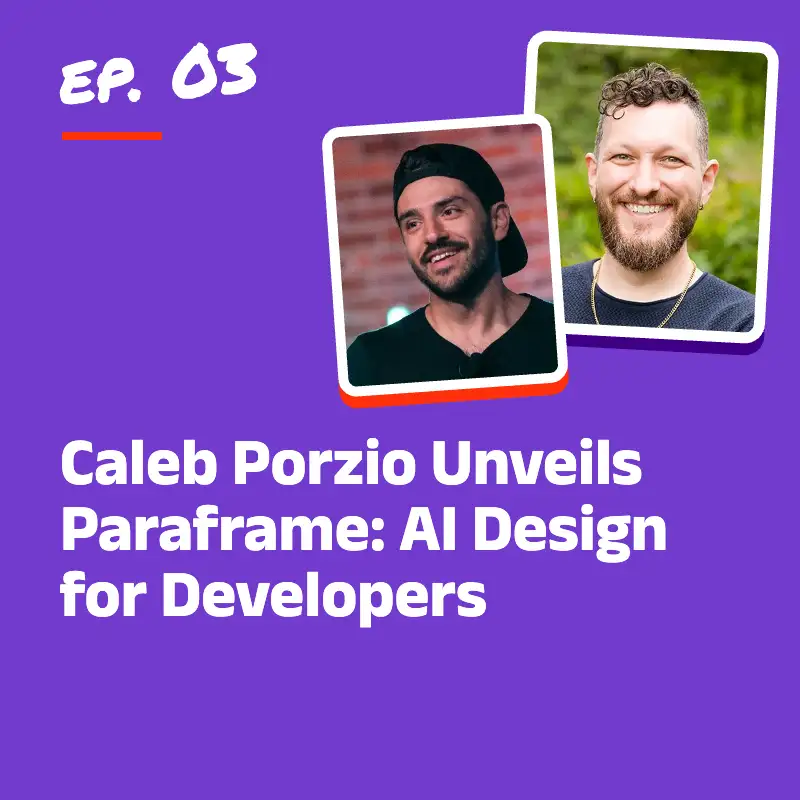
Caleb Porzio Unveils Paraframe: AI Design for Developers
Matt Stauffer:
Hey, and welcome back to Laravel Podcast season eight. I'm your host, Matt Stauffer, CEO of Tighten. And in this season, I'm bringing members and friends of the Larville community to talk about what's on their minds this week. My guest today is Caleb Porzio, member and friend of the Laravel community. Not member of Matt Stauffer but friend of Matt Stauffer. Caleb, welcome to the pod. Thanks for hanging,
Caleb Porzio:
Thanks for having me, Matt. Good to be here.
Matt Stauffer:
dude. Uh I've
You know I need to do is I need to count like how many times has somebody been on the podcast every time they come? Because Eric told me that he's never been on before and he we turned we discovered he had been. Uh
Caleb Porzio:
yeah.
Matt Stauffer:
so I'm I'm confident you've been, but I I don't know when or where, right? Yeah.
Caleb Porzio:
I don't recall, honestly. Ma it would have been a while ago, but
Matt Stauffer:
Laravel Podcast. Now let's go learn. Uh
Caleb Porzio:
Yeah, we gotta know.
Matt Stauffer:
Routing and Blade, twenty twenty. I do remember that. So I
Caleb Porzio:
Hee hee hee. Routing and blade. That would be fun to
listen to.
Matt Stauffer:
I mean it's fun because I mean your
life still does I mean, you do a lot of blade, right? In routing. Yeah, sure, right? Um do you don't do
Caleb Porzio:
Involve routing and blade. No, I don't. No one writes code anymore, Matt.
Matt Stauffer:
okay, okay, you know, let's go there.
Caleb Porzio:
Yeah.
Matt Stauffer:
What so so I told you this ahead of time and I told you I wasn't gonna tell you until we're actually on the podcast, and now can tell you
Caleb Porzio:
Yeah.
Matt Stauffer:
I would have loved to gone back and listen to every single episode of every single podcast that you've done over the last while, but as we were talking about beforehand, I'm just total crap at listening to podcasts.
So I was like, Well, I will go and I'll read through the descriptions for all of his podcast episodes. Well, you don't put descriptions in your podcast episodes.
Caleb Porzio:
Yeah. No, no.
Matt Stauffer:
And not only that, you have really fun, goofy titles. Let's let's let's pull up some of these notes on work titles so that
Caleb Porzio:
You know, I try to
actually be like fairly it's funny that you think they're fun and goofy, 'cause they could be so much worse. I try to make so that you could sort of get an idea of if you wanna listen to it or not, you know?
Matt Stauffer:
Okay, so here's
the most recent one. It's insane to me that people are still dot dot dot. Which is kind of fun, but it
Caleb Porzio:
yeah, yeah, yeah.
Matt Stauffer:
does give you a little bit of an understanding of what you're gonna deal with. The next one is
Caleb Porzio:
Yeah, yeah, yeah.
Matt Stauffer:
by golly, if I'm not all in on Opus, okay, I know you're you're excited about, you know, Opus. Uh-huh.
Caleb Porzio:
Right, yeah, right. You know what this is about. Yeah.
Matt Stauffer:
The previous one is what makes a man. And I think part of this is that about what makes
Caleb Porzio:
And that one is actually literally about manhood.
Matt Stauffer:
a man. And the thing is, like, if s if it I'm what I imagine is it does a really good job of describing it, but as from the outside,
I don't know anything other than maybe that Caleb's thinking about what makes a man. So I'm like, okay,
Caleb Porzio:
Yeah, yeah.
Matt Stauffer:
I like I'm getting something. The previous one before that, in all caps, what did you expect? I'm like
Caleb Porzio:
Yeah, yeah, yeah.
Matt Stauffer:
like and I'm sure that is relevant to what it was the topic
Caleb Porzio:
I wish I remembered all of these topics, 'cause I feel
like that was a good one of what did you expect? Shoot, I don't remember why I said that. I just remember screaming like, What did you expect to happen? you know?
Matt Stauffer:
Yeah. And then back September twenty fifth we have I don't frickin' know.
Caleb Porzio:
I don't remember what that was about either.
Matt Stauffer:
Exactly. So I was
like, I'm gonna figure out like what's been on Caleb's mind, and and it was just this very hilarious. we've got some dudes
Caleb Porzio:
Yeah, yeah, yeah.
Matt Stauffer:
rust macro, um, me reading a chapter of hidden multipliers by Jason Cohen. I hate everything after two weeks. I'm like, okay, you know, like I'm getting senses of what's going on about what you're thinking about. Uh
Caleb Porzio:
Yeah, yeah. Yeah, yeah, yeah, right. But you're not known. Yeah, of course. Philippe, my my guy, my number two here,
he reads the transcripts and decides if he wants to listen to it. I didn't know there was transcripts. maybe there's not. Maybe he makes transcripts. I wouldn't put it past him. Yeah, right. I because that's cheating. Like Philippe, you can't that's not okay. That's not how you
Matt Stauffer:
I didn't know there's transcripts either. Hold on, let me go here. He does. There's you do not have transcripts on your um your transistor. So he must
have something downloading the MP3, transcribing it. So I've done that before. I've done I've been in the middle of a workday and a podcast episode comes out that I know is important, and I'm like, I can't listen to this hour and a half long podcast for the next three days. So I'm in the background being like
How do I download an MP3 that then goes to a transcription and what service can I use? And I remember like I eventually ended up getting, I think, Whisper Flow or Super Whisper or whatever my, you know, like talk to your computer. Like I ended up discovering you can just drop an MP3 onto it. But I remember it was like in the middle of meetings. Yeah.
Caleb Porzio:
Oh funny. I use Whisperflow constantly. I didn't know you could do that.
Matt Stauffer:
And I don't know which one it is, but whichever one it was, I you just drop a MP3 onto the
Caleb Porzio:
Yeah.
Matt Stauffer:
freaking thing. And I was in the middle of meetings trying all these things with like FFMPEG and all these other things, and then discovered I just had an AI app just sitting there that just did it for me.
Caleb Porzio:
Yeah.
Yep. Yeah.
Matt Stauffer:
So all this
came from you telling me that nobody writes code today. Uh I don't I don't believe that you don't write code because I have seen your Twitter, which was also a thing I looked at. And one of the things that I thought was fun um was that you said, actually hold on, I'll have the tweet. But basically you had a picture of like your AI agent working and then also your like hand drawn, you know, you're like, I don't freaking care what
Caleb Porzio:
yeah yeah.
Matt Stauffer:
the implementation thing is. I'm just doing the right implementation for each moment, right? Like, do you ever Good.
Caleb Porzio:
Yeah. It's pretty much like I
uh I have discovered okay, I haven't talked about so much publicly 'cause it's been I've been working on a project in secret for like a month and I haven't talked about it
Matt Stauffer:
Is it the one that says
business is katan and I'm building something new? Was that what you were talking about? That's one of your podcast episodes This is what I'm
Caleb Porzio:
What's that? That's one of your podcasts.
Matt Stauffer:
telling you. Of from from the October sixth episode of Notes on Work, I intuited that my friend Caleb is building something new.
Caleb Porzio:
Funny. That is the thing. I didn't so I guess maybe I've mentioned that I've worked on it, but it's not like everything else where I talk about it. I di I've and
Matt Stauffer:
Mm-hmm, mm-hmm.
Caleb Porzio:
I need to start talking about it. I want to start talking about it, but I've just been like, you know, it's that that honeymoon phase where
Matt Stauffer:
Uh-huh.
Caleb Porzio:
you're just like uh you know, it only gets worse from here, you know, when you're building something. So
Matt Stauffer:
Yeah. Uhhuh. I d I absolutely know. Yeah.
Caleb Porzio:
it's like, I just don't wanna, you know, muddy the waters. Let's just stay
Matt Stauffer:
Yeah.
Caleb Porzio:
in the honeymoon. I don't wanna like
So but now I actually so I shipped it to some beta users at their company. Like I went to their company and trained them for two days and um
Matt Stauffer:
Nice.
Caleb Porzio:
and got all using it and they love it and it's uh so I mean I'll talk about whatever you want. We do not have to talk about it's called Paraframe. because I have to ship the stang thing like in a week or two. Yeah. We should, but the remote Okay. So hopefully
Matt Stauffer:
I mean if you if you w if you wanna talk about it, let's talk about it. This comes out I think a week from tomorrow, I think, so that would be
Caleb Porzio:
there's at least a bunch of people getting in like a beta or something. Um
Matt Stauffer:
Okay.
Caleb Porzio:
but we should definitely talk about it 'cause we'll get tighten on it, you we'll get we'll get every I'm
It's w I'm actually building something for the first time I feel like like I c I'm out to dinner with anybody and I'm like, we'll get you in para frame. You know, like it's
Matt Stauffer:
Yeah.
Caleb Porzio:
generally useful to anybody working on anything visually. Um,
Matt Stauffer:
Okay.
Caleb Porzio:
but the reason I brought that up was I don't talk about anything. What did you say? What did you say that sent me on that? You're not gonna remember. You're fuzzy.
Matt Stauffer:
Something about a
new business.
Caleb Porzio:
I don't know. But I don't talk about things lately. do I write code? Yeah, yeah. So for a while,
Matt Stauffer:
Yes. huh.
Caleb Porzio:
like if you listen to my podcast, you'd be like, the last really strong statement I've had about like, should you write code or not, whatever, is it's me yelling into the screen that like everybody's saying that you don't write code. You don't have to write code anymore, whatever. I just do not find this to be the case. Like I care about confidence. That's the only thing I care about. And right now, I cannot get the level of confidence that I need by just vibing out.
You know, there's just in and there's
Matt Stauffer:
Hundred percent agreed. Yeah.
Caleb Porzio:
no everything I've tried everything to get at that level of like, write me a frickin' screenplay and produce it, get me to understand the thing, you know, whatever. Have ten agents review it. And I still I just don't have the confidence. Um but I've found I I suspected when I was in that state and so many other people weren't, is that open source is somewhat different because it's like, you know, the thing I'm shipping, there's high stakes, like
Matt Stauffer:
Uh-huh. The expectations are so high. Yep.
Caleb Porzio:
and
The the interface of it is the code itself, you know. So it's like if the AI writes some sloppy implementation, it could mess with some part of the public facing API, and then somebody perceived my thing as slop. So I'm very careful with the open source stuff, but the uh but I'm working on an actual product now that users use with
Matt Stauffer:
Yeah.
Caleb Porzio:
their mouse. And I haven't read a line of code, like a single
Matt Stauffer:
Yeah.
Caleb Porzio:
line.
Matt Stauffer:
Cause the users are not interacting with your code, they're interacting with the user interface, right? So
Caleb Porzio:
Exactly.
Matt Stauffer:
like you feel like you're gonna be judged based on your user interface, not based on your code, at which point code becomes an implementation detail. Yeah.
Caleb Porzio:
Yeah. So the code doesn't mat right. And it's in like
a you know, it's starting to be like a real app, so I'm starting to you know, we're like Philippe is the guy who cares about, you know, making sure it's secure and having everything check all the different things and we try to attack it and things like that. But but for me it's like I just go, Does this thing work incredibly well? And is it designed exactly the way I would want it to be? But it I use this phrase called true sight that I really,
Matt Stauffer:
Okay.
Caleb Porzio:
really like. It's like
This was when I was in the throes of, I felt like everybody on Twitter is screaming at me like, you don't have to read the code, like you don't have to look at the code. And
Matt Stauffer:
Uh-huh.
Caleb Porzio:
I'm like, there's some either you have way lower standards than me, or you're working in some other way. There's something different about our projects. And I think the answer is a little bit of both, but mostly the difference in projects. And basically I like coined this term. It's not a whatever, I didn't coin the term, but I started saying it a lot. It's like, all I need, I don't care how I get it.
Is true sight. You know, like think about three years ago when you're working on a feature by hand. You're like your face is this close to the code. You know, you're writing every conditional, every parameter to a method you're naming. And all of that time spent in this small place, your brain is going, but does this match that distant thing over there that I spent a week on last time? And you know,
Matt Stauffer:
Mm-hmm.
Caleb Porzio:
every it's true sight. Like you, the whole machine, all the code.
Is written on the screen and also in your brain. Right? Like
Matt Stauffer:
Yeah. Fully.
Caleb Porzio:
you know this. You're a programmer. You could run the program in your head. Like that's true sight. Like you, and when you start vibing, you lose that. The machine is gone. It doesn't exist in your head. You know? Um, so anyway, that's like, how do I get back to that true sight, but still move fast and still do big things, but still feel like, you know, like when your vibe slop.
Even if it looks good squinting, you have an idea internally of like how accounted for every word and pixel and menu and context menu, you know? And you just, yeah,
Matt Stauffer:
Yeah. Is or is not. Yeah.
Caleb Porzio:
and true site is fully accounted for, you know.
Matt Stauffer:
Mm-hmm.
Caleb Porzio:
So anyway, paraphrase is basically my answer to that these days. It's like, how can I fully take ownership of an interface down to the pixel and still be able to move mountains with AI, you know?
Matt Stauffer:
I'm having a hard time not just instantly jumping to it. We should probably kind of finish where we are here. Um I just gave a talk at Laricon AU, you know, a couple days ago at this point, um, about uh they asked us me to give a talk called Keeping Your Taste, being basically like how do you continue to have taste about how code is written when you're not the one your fingers on keyboard and actually write not actually writing the code. And I didn't say to true sight. Um, but I do think that like
If you're not able to see your code to a level when you know when something's wrong, then your taste taste is certainly not able to be consistently applied. You can apply taste in the the the introductory level, you know, in a prompting or whatever, saying, I want it to be like you can set you can apply taste from a um from a code standards, right? You know, whether it's automated code standards or code standards that are in agents.md. But at some point, if you don't know what the thing looks like, how can you really be sure that it is what you want it to be? And so
That's the hardest thing for me about don't write the code. Um, one of the things you mentioned earlier, um, when you're talking about like I feel different when my my delivery is open source. That's the thing I've discovered is a different and if I'm talking to Adam Wathan and Ian Landsman and John O'Nolan and a lot of our other friends who are very AI pilled, um, very don't read the code, I'm like, yeah, because you are delivering a product, you're not delivering code. And as a consultancy
We're delivering both, right? Because we're n we're never and that like if you think about like what what happens what
Caleb Porzio:
Yeah, yeah. Yeah, that's true. Right.
Matt Stauffer:
happens if there's a bug in your code? If your answer is I just point my agent at it, that's different than somebody else has to deal with it, right? If somebody else has to deal with that bug, then my expectations for the quality of my code has to be different, right? And you as an open source creator and me as an open source creator, but also as a agency owner, we're gone at some point, right? At some point, this customer
is not just experiencing the user interface that we built, but it's also experiencing the code that we delivered. And so we just have different sets of expectations for what we're delivering. And I think that's the biggest delineator between how people are looking at it that I've seen so far.
Caleb Porzio:
And if you enter a code base as an agency, there's some amount of like honoring the existing, you know, decisions
Matt Stauffer:
Yeah, yeah.
Caleb Porzio:
that if it's your own product, you know, who cares what the AI does. But yeah, there is
Matt Stauffer:
Yeah, for sure.
Caleb Porzio:
a little bit more transparency into the code base, like accountability for what's going on inside in your position. And so that company that I was at earlier in the week, they read code a lot more than I'm doing
Matt Stauffer:
Mm-hmm.
Caleb Porzio:
with Paraframe. Um, and they care about it because
Well, it's like for go you know, it's it it's it's an actual in production funded tool that tons of users depend on and governments
Matt Stauffer:
Mm-hmm.
Caleb Porzio:
use and that you know, it's a different level. This is not
Matt Stauffer:
Yes.
Caleb Porzio:
me making something with for ten users in an with Play Doh, you know. So
Matt Stauffer:
Yes.
Caleb Porzio:
there's there's diff there's uh context is incredibly important and the this the whole podcast, the you're in insane if you're not whatever was I I think Theo tweeted like
You're an insane person if you're not using uh GUI, maybe for your agents or something. I was like, so
Matt Stauffer:
Mm-hmm.
Caleb Porzio:
I just list the amount of times somebody has told me you're insane if you're not in the past year
Matt Stauffer:
Uh-huh.
Caleb Porzio:
for ever you're insane if you're not using a terminal was the first thing. You're not insane if you're not using Claude code in the terminal. You know, it's in now
Matt Stauffer:
Yeah, huh.
Caleb Porzio:
it's like you're insane if you're using an editor, if you're looking at the code, if you're not using, you know, if you're all if you're local development, you're insane. Like that's insane behavior.
Matt Stauffer:
Yeah, that is the latest.
Caleb Porzio:
If you're
not using a bot that has a VM that hooks up to the cloud,
Matt Stauffer:
Uh-huh.
Caleb Porzio:
you're insane. It's like, dude, all of this is noise and we will converge around the great ideas. But at the end of the day, what matters is you're building something and telling an agent that's capable and has a great model to change it and going, That's what I want. You know, whatever. They all have their pros and cons, but but uh, but yes, that it's so contextual. An agency situation is different than an open.
source maintainer situation is different than a proof of concept. It's it's so different. Um yeah.
Matt Stauffer:
Um, so
before we get to Paraframe, because I I a s I kind of imagine it's gonna take up a lot of our time. What today today
Caleb Porzio:
Yeah yeah. There's so many other things to talk.
Matt Stauffer:
I imagine, um, because I I did do like a 2x skim of your latest episode, and then I'm also looking at your episode titles. So I imagine that you're using Opus through Claude Code on the terminal. You've got at least one I don't know how to call the open claw descendants, but like always on agent. I think you're using Grokbot right now.
Caleb Porzio:
Yeah, yeah, yeah. Dot, Grockbot,
all that, yeah.
Matt Stauffer:
Yeah,
uhhuh. Um, what other systems are you using that you really rely on uh
Caleb Porzio:
Yeah.
Matt Stauffer:
consistently?
Caleb Porzio:
Yeah. I think Claude code on Opus five point five in the terminal, but even bigger than Opus five point five, I think Claude code is there's like two really serene tools that have stood the test of this small amount of time, and it's
Matt Stauffer:
Uh-huh.
Caleb Porzio:
Chat GPT in your browser and just talking to it, and then Claude Code in your terminal. Like
Matt Stauffer:
Yeah. Yeah.
Caleb Porzio:
nothing has dethroned these two things for me.
Matt Stauffer:
Uh-huh.
Caleb Porzio:
And I've used them all and I still open the desktop apps and all that crap, but it's
Matt Stauffer:
Uh-huh.
Caleb Porzio:
like
There's something sacred to me of
Matt Stauffer:
Yeah.
Caleb Porzio:
us of Claude code in the terminal and chat GPT in the browser.
Matt Stauffer:
Okay, so let's
start with chat GPT. Why in the browser versus the desktop app? What's the difference?
Caleb Porzio:
Oh, right. I I guess I still think of that as codex. Um but
Matt Stauffer:
Oh, yeah.
Caleb Porzio:
no, yeah, I love it in it's because it's like this era's Google. I am not a
Matt Stauffer:
Mm-hmm.
Caleb Porzio:
huge fan of desktop apps, and Paraframe is a desktop app. It's like
Matt Stauffer:
Interesting.
Caleb Porzio:
I like just hitting new tab, typing ch and enter. Same thing as Twitter. Like I never had a Twitter desktop app, you know? One of those Twitter thingies that people had, whatever. Yeah, an email, it's in a browser tab. I'm a I'm a browser guy.
Matt Stauffer:
Uh-huh. Uhhuh. Really? So you how many pr how many browser tabs
do you have open right now?
Caleb Porzio:
I I've been on my best behavior and I think there's like thirty, maybe fifty. Uh you know. I it could be hundreds. I'm usually there too. Yeah.
Matt Stauffer:
So and that I'm I'm I'm usually there too. I just
got off of a twenty six hour travel day, so I actually got myself down to six tabs because I'm like, I guess this is the time to do these things. But that's where I live.
Caleb Porzio:
Right. I have like seven
seven pinned tabs always. You should make those ones pinned. No, no, no. Command T
Matt Stauffer:
Oh are any of them chat GPT and Twitter and stuff like that? Okay.
Caleb Porzio:
T W enter. Yeah.
Matt Stauffer:
And do you ever keep it open? Do you have like six tabs that are all Twitter, four tabs that are all Chat GPT?
Caleb Porzio:
yeah, yeah. I open them and I don't close them. They they
Matt Stauffer:
Right.
Caleb Porzio:
get closed in batch, you know. It's like your room. Like you make a little mess, but with a computer we have a button where we can
Matt Stauffer:
Uh-huh.
Caleb Porzio:
say like clean it all up. Boop. Yeah.
Matt Stauffer:
Totally. Uh
so this is why I like a desktop app because there's all always only one Twitter. There's always only one Chat GPT, there's always only one Claude, and and s and so I can right. Uh the I I
Caleb Porzio:
Uh GPT. That's an interesting way to think about it here. Yeah.
Matt Stauffer:
have a Gmail app pure because there's always only one Gmail and I know exactly where it
Caleb Porzio:
Mm.
Matt Stauffer:
is and I know how to get to it, versus I'm constantly spawning seven new instances of Gmail that I have to go back and clean up later. It's kind of nice. Okay.
Caleb Porzio:
I will have to think about this because I
I'm sort of so I'm building so Paraframe, there's a lot of AI in it and so
Matt Stauffer:
Uh-huh.
Caleb Porzio:
I'm encountering a lot of the same like decisions and patterns and and there's a temptation to make things organizable, you know? Like
Matt Stauffer:
Mm-hmm.
Caleb Porzio:
let's just say for chat, like chats and you could put them in folders and there could be projects, you know, like Figma type thing. Paraframe's
Matt Stauffer:
Yeah.
Caleb Porzio:
like a design tool like Figma kinda.
Matt Stauffer:
Okay.
Caleb Porzio:
So you could like do all these things, but something when I open ChatGPT, there's a meta thing here, but inside ChatGPT, you create a new app. You never attempt to name it, you never attempt to organize it. It's something you create and you forget about, and it just gets washed away in the river. And you could like swim downstream and go find it, but you never do. It's just washed away.
Matt Stauffer:
huh. Uh huh.
Caleb Porzio:
I want tabs to be this way in my browser. I think the problem is they make you feel like it's something you need to clean up. You know? Anything that can be cleaned
Matt Stauffer:
Yeah. Versus it just going away over time.
Caleb Porzio:
up is a problem because it creates
Guilt for me as an ADHDer, anything that can be
Matt Stauffer:
Hundred percent.
Caleb Porzio:
organized or cleaned up, it just creates guilt and stress in my brain. And I want to create
Matt Stauffer:
Uh-huh.
Caleb Porzio:
one of my like aims with Paraframe and decision making frameworks is I want this to be the ADHD tuned tool so that you're
Matt Stauffer:
Uh-huh.
Caleb Porzio:
never tempted to organize something for two days and get really excited and then let it decay and abandon that organizational strategy. It's
Matt Stauffer:
Yep. A hundred percent.
Caleb Porzio:
like the river is flowing, you
Matt Stauffer:
Yeah.
Caleb Porzio:
get in it, and then it just goes on.
And then every time you get to experience a clean room. And when I type command T chat, I have a clean room. If I had the desktop app, I guess I would just do Command N. I I never navigate chats, but if you have the desktop app, you would navigate chats, right?
Matt Stauffer:
Yeah.
Well the base so if you open the Chat G GPT desktop app, it's not Codex. It is ChatGPT. So I'm sure I could get to a Codex view if I
Caleb Porzio:
Right. Yes. I guess I they have renamed it.
Matt Stauffer:
wanted. Um, but I mean it looks just like
Caleb Porzio:
Um
Matt Stauffer:
the the the web version. So the only difference is when I click on it, it has
Caleb Porzio:
Mm.
Matt Stauffer:
whatever my most recent chat was. So yeah, I'll hit Command N. I get a new chat, but I'm not going there's nothing about it that makes me feel guilty about hitting Command N when I tab over to it. So the last the last chat GPT chat I had was asking
Is this email from reportedly from Apple about my artwork actually legit or is it somebody trying to scam me as a podcaster, right? I don't feel guilty about pushing that down the history when I come over and I need I a new conversation I want with chat. I just hit command in and that's it. Similar to you don't you don't go to your browser and say, I gotta check to see if I have another chat GPT tab open before I create the new chat GPT tab.
Caleb Porzio:
Course.
Matt Stauffer:
And so because this whole like you have the history of your own conversations in the sidebar.
You can get back to them if you want. You have this freedom to do it, but because it's a single window, it locks it into only ever having one open at time. And I like that because that is that's the automatic cleanup, right? The automatic cleanup is the moment I have a new chat conversation, the old chat conversation is moved to the archive. Whereas with tabs, I can have 20 of them open at the same time. And then now I have to feel like, oh, should I keep that one open? Is that one open because it's
Caleb Porzio:
Yeah, yeah.
Matt Stauffer:
an important thing that I wanted to get to? And then each of those tabs becomes like a remind right, like your open tabs are basically to do list items.
Caleb Porzio:
Yep, definitely.
Matt Stauffer:
I want less. I want less to do list items.
Caleb Porzio:
So tell me this. If you open ChatGPT right now, so like I see recents in the desktop app on the left sidebar at the bottom, right? But I also have like pinned and projects, like things like that. Do you have any of that stuff on top of recent? And be honest, you cannot lie. I will know.
Matt Stauffer:
yes, but they're closed
because they're messy. Uh
Caleb Porzio:
Okay, but what are they?
Matt Stauffer:
so let's see, pinned, uh Honda Pilot versus Rivian. I've been doing No, I mean I'm just telling you, like they're they're they're
Caleb Porzio:
You you don't have to read the very specific ones in pinned. But there's there's pin
Matt Stauffer:
like the long running conversations that I find myself constantly coming back to. So for pinned,
Caleb Porzio:
Okay.
Matt Stauffer:
it's like, you know, hiring a editor for clips. I have been thinking about this for ages about hiring someone to edit the clips for my podcasts.
there's one about getting fit. It's like the things that I constantly see myself returning back to. Basically, if I have
Caleb Porzio:
Yeah.
Matt Stauffer:
to go into recents more than once for something, I'm like, that needs to be pinned. And then projects.
Caleb Porzio:
See, that's a problem. We're we're having problems already here.
Matt Stauffer:
Okay. So let's let's talk about that and I'll tell you about projects. What's the problem about that?
Caleb Porzio:
The problem uh tell me about project.
Matt Stauffer:
Okay. projects. I've got basically any time I found myself doing a whole bunch of things around a topic, a whole bunch of chats around a topic, and I want to be able to like refer to one and the other. Um, but remember, all of these are closed. They so though there's like you can expand it, they all stay unexpanded by default. So there's no like
Caleb Porzio:
Yeah. Sure.
Matt Stauffer:
visual weight to have to see them.
Caleb Porzio:
Yeah, it's not about the visuals, Matt. So this is the thing. This is the thing.
Matt Stauffer:
uh Tell me.
Caleb Porzio:
What you're doing is fine.
Matt Stauffer:
Mm-hmm.
Caleb Porzio:
These are useful things. My Chat GPT app has the same thing. However,
Matt Stauffer:
Uh-huh.
Caleb Porzio:
when I look at my ChatGPT app and I look at pinned, I go, yeah, yeah, yeah, yeah. Those are things that I did care about at one point and put a lot of effort into like making this like the home for like GitHub releases. I that's a blue dot. I will never open again. And
Matt Stauffer:
Uh-huh. Then unpin
Caleb Porzio:
This right, okay. well, right, right. No, no, no, no. See that? No,
Matt Stauffer:
it immediately. In this second
Caleb Porzio:
that's like telling me, like, uh those pants you just threw on the ground? Like,
Matt Stauffer:
Mm-hmm.
Caleb Porzio:
go clean them up right away. It's like, oh, you're so right, but that's not
Matt Stauffer:
You are
Caleb Porzio:
conducive to the way my brain works. But here's what I'm saying you can
Matt Stauffer:
Uh-huh.
Caleb Porzio:
find this useful and you can use this. Would you open a Google application on your desktop, type something in and go, you know what? I'm actually been finding myself searching Tailwind to go to the doc slot. I should pin that. Google should make me like, no.
Google is this like unbelievably pure command T G O type in and it's it's as it's a leaf fr on a falling off a tree. It's like you don't even think about the weight of it. And I love that
Matt Stauffer:
Which is interesting.
Caleb Porzio:
Chat G BT feels that way to me.
Matt Stauffer:
Because Google will often, I don't I don't remember if it's the search engine or the browser, say, Oh, are you trying to get back to this previous search thing that you did? Yeah, that's a thing. Yes.
Caleb Porzio:
Really? No way.
Matt Stauffer:
I don't know if it's the browser or Google. like the search engine. Yes. I have had it say, you're searching about Rivian again? Here is pick up from where you started last time or something. And that's the thing. So, like, for example,
Caleb Porzio:
That's crazy.
Matt Stauffer:
I will be I got in a no, Imani got in a Kia carnival.
And she texts me and she's like, Hey, I know that you don't want a minivan. Conversation for you to me to have because you think they look terrible. But first of all, I love this carnival. It's really great. And second of all, it's hybrid. And third of all, it's not as ugly as most minivans. And I was like, Right? And it looks a little tiny bit more like an SUV, you know, cause
Caleb Porzio:
Yeah, they're little more dynamic. A little pointier. Yeah, little small, a little shorter.
Matt Stauffer:
Uh-huh. So I was like, okay, cool.
I have a long running thread where I have talked about all the pros and cons of the various things. So what I want to do is I want to compare the carnival against the pilot, the Rivian, the EV9, and couple others. I don't want to start from scratch. No, I d I dose these are my top choices, not the things that will ema or emasculate.
Caleb Porzio:
You didn't even say Siena or Odyssey. He's just shaking his head. 'Cause these are your top choices and you're you're you're just not e you're not even looking at them. This is insane.
Matt Stauffer:
What's the word? Anyway. Um and so I want to find that chat where I have
Where I've talked about what are the factors they care about. I've got a little table about each of them or whatever, right? I hate searching through conversation histories. That's one of my biggest pet peeves in the entirety of all user interfaces.
Caleb Porzio:
Yeah.
Matt Stauffer:
Searching for mail, searching for chat messages, searching for chats and chat GPT. It's miserable. And I don't know if you've found that, but they all suck. Okay. So so so if you w had this.
Caleb Porzio:
Hmm. Yeah, I've never searched for a chat in Chat GPT. It's always green field. It's like what I don't know where that was. I'm
gonna open a new chat.
Matt Stauffer:
So if you had this great conversation about Honda Pilot versus Rivian versus whatever, and then a month
Caleb Porzio:
Yeah, yeah. Right.
Matt Stauffer:
later you want to add a new one and be like, Hey, you know that table? Let's add another entry in the table.
Caleb Porzio:
Yeah.
Matt Stauffer:
You're like, I guess I'm creating it from scratch.
Caleb Porzio:
Yes. The problem is long running things can't exist. I have to buy a car as well. And I had similarly,
Matt Stauffer:
Why not? Uh-huh.
Caleb Porzio:
like I had it build me this whole car buying app where it like scraped all this stuff and showed me all
Matt Stauffer:
Mm-hmm.
Caleb Porzio:
the whatever, all that stuff and whatever. It just anything long running like that. Okay, you know what I'll say? This is what I'll say.
Matt Stauffer:
Uh-huh.
Caleb Porzio:
This is it. You're allowed to have one long running ledger, okay,
Matt Stauffer:
Uh-huh.
Caleb Porzio:
of things. So I have a I have this for workouts.
I also have it for finance like things, and it is Google Sheets. You
Matt Stauffer:
Two. Uh-huh.
Caleb Porzio:
may create a long running sheet and you may also
Matt Stauffer:
Uh-huh.
Caleb Porzio:
pin that in your browser.
Matt Stauffer:
Uh-huh.
Caleb Porzio:
but now when you go to the gym, you open your workout sheet. Now once a month you open your your money sheet and you also you buy you open your car buying sheet and then you open
Matt Stauffer:
Uh-huh.
Caleb Porzio:
a new session in whatever your AI is and just say, yeah, it's in my Google Sheet. Like, go add this or check or whatever.
Matt Stauffer:
So you're you accept the long runningness, but you don't allow the important information to live in a chat. It has to be exported somewhere else. That sounds like more work. Okay. Uh-huh.
Caleb Porzio:
Yeah, yeah. And it and Google Sheets is the only place. And because you can only have three also to your name. You can only have three
Google Sheets, period.
Matt Stauffer:
I mean, it's interesting because
I do find that there are I don't know why the word modalities popped up, but there are modalities for building with AI that I also don't know if it's correct. Okay, great.
Caleb Porzio:
I know, you always feel like such like a douchebag when you say modalities. It's a good word though. Right. And I don't know if it's correct either.
Right.
Matt Stauffer:
But let's pretend like it is. where I have struggled to have persistent data storage and things that are generated with AI. And I talked to somebody else who's having the exact same problem, they're like, I just threw the thing in in Google Sheets. So clearly I need
Caleb Porzio:
Yeah.
Matt Stauffer:
to start leveraging Google Sheets more as a data store for my AI conversations. But still, if
Caleb Porzio:
Yeah.
Matt Stauffer:
I were to grow in that way, the idea that I mean, let me just pull up the Honda Pilot versus Rivian.
So I've got a couple things. I've got its most recent. Hey, I think this is your short list and why. This is plain text. This is not something that fits super well in Google Sheets. We've got the a little bit before I was looking at what's the cost per gallon over a hundred thousand miles about the carnival hybrid versus the EV9 fully electric. Um, you know, and then I've also got a sheet, which is the hybrid versus the grand highlander hybrid versus the EV9.
on all these very the third row leg room and cargo behind the third row and max cargo and so I'm like
Caleb Porzio:
Yeah.
Matt Stauffer:
this is a this is a whole like the history of the conversation is valuable to me you know the his
Caleb Porzio:
Yeah.
Matt Stauffer:
and there's lots of different structures of data not just a sheet I love this I love coming back to this and throwing in hey add this new vehicle or add this new factor or whatever and it knows if I say you know what I realized I had not been thinking this whole time
Uh, we have to take trips out of town and blah, blah, blah, blah. And it can look at my whole history versus if I wanted to start this conversation fresh, I'd be I'd have to do this extra mental work of summarizing the entirety of the history. How do you solve for that?
Caleb Porzio:
Right. Of course there's the opposite
problem of this where you go, Can you please add this to the list? And you go, well, seeing is how, you know, you it's uh I don't know, like I'm trying to think of something funny, but how it brings up things that you said way long ago and you forgot and they're totally wrong now. Like
Matt Stauffer:
Uh-huh.
Caleb Porzio:
that's the problem with long running conversations is you could just say context
Matt Stauffer:
Does that bother you?
Caleb Porzio:
rot as like, you know, yes, I always it's there's like how many times do you open chat GPT? If the answer is none
This is going to be crazy to me. Do you hit the temporary chat bubble at the top right? Incognito mode.
Matt Stauffer:
I didn't know it existed. Didn't
know it existed. Yeah.
Caleb Porzio:
That's crazy. Because
also you might be on the this is another reason why to not use the desktop app
Matt Stauffer:
Uh-huh.
Caleb Porzio:
is because I don't even know if it exists there. Okay, it does. Because when you use a desktop app version of something, it's not always like in full parity with the UI. And the web app
Matt Stauffer:
Yeah, a hundred percent. Yeah.
Caleb Porzio:
is the flagship thing. So like I don't want to use some stepchild of the web. I need to be on like the evergreen thing that represents your product. You know, I can't be on
Matt Stauffer:
Uhhuh. Yeah, for sure.
Caleb Porzio:
some sidecar thing.
It is actually in the desktop app. They've made it much more like
Matt Stauffer:
Yes, I see it now.
Caleb Porzio:
actual Chat GPT. This is something, and I'm telling you that you're crazy because I've talked everybody I've ever said this to is like, yeah, yeah, all the time. So let me introduce you to this, Matt.
Matt Stauffer:
Never heard of it. Yeah. huh.
Caleb Porzio:
Do you ever talk to ChatGPT and it says, well, first it mentions your wife's name, period. Yeah.
Matt Stauffer:
huh, it creeps you out.
Caleb Porzio:
And then tells you random things that aren't even true about yourself, like, because because you're s uh like a a safety inspector or something, like I told you that to get around you not letting me.
Matt Stauffer:
Uh no, 'cause I didn't
Caleb Porzio:
Change my house, you know, and like now.
Matt Stauffer:
I don't do that stuff.
Caleb Porzio:
Yeah, but it it's just random stuff. It'll talk to me. It talks to Hannah. My talks to my sister like a girlfriend. Like their cab like emojis and things. I'm like, your chat's nuts. Like mine is
Matt Stauffer:
AI psychosis is real, man. I hate it when it when it gets to that point. Uh-huh. Uh-huh. Yes.
Caleb Porzio:
so different than yours. Um, I have German chat GPT. She has, you know, I guess I have like bro, more like bro-ey chat GPT, I guess.
Matt Stauffer:
You
have Chat GPT that reflects how you talk to Chat GPT. That's the thing. She talks to it to
Caleb Porzio:
Yeah, it swore at me.
Matt Stauffer:
like a girlfriend and so it talks to her back like a girlfriend.
Caleb Porzio:
Yeah. I didn't know I swore at Chat GPT until it swore at me. And I was like,
Matt Stauffer:
Yeah.
Caleb Porzio:
the only conclusion here is that I occasionally swear at ChatGPT. But anyway,
Matt Stauffer:
Yeah. Yeah.
Caleb Porzio:
Matt, what you're doing is you're in a state where you don't know what it knows. This is a stressful experience as a user. It's opaque.
Matt Stauffer:
Okay.
Caleb Porzio:
You don't know what context is influencing your things. When you go, when if I go to make pumpkin muffins in ChatGPT, this happened. I am stressed out because I start to question, I'll see tiny little things and start to question.
How much is this pumpkin muffin recipe driven by something I said two months ago about wanting less sugar or something?
Matt Stauffer:
Hm.
Caleb Porzio:
You know what it's like, I need incognito mode so that you tell me the pumpkin recipe. So that
Matt Stauffer:
Okay.
Caleb Porzio:
you don't start tailoring things and getting, you know. Interesting that you that you don't find the impulse to do that.
Matt Stauffer:
Uh d is there a way to count? I've
just Googled this. Is there a way to count how many chats you've had with chat? Because I have a strong, a very strong suspicion yours is between ten and a hundred X mine. I don't use chat very often. Yeah. I mean I probably I
Caleb Porzio:
really? You mean you don't use ChatGPT very often?
Matt Stauffer:
don't use any of these these AIs very often. I'm one of the least AI pilled people you know who understands and can work with AIs.
Caleb Porzio:
Yeah, yeah.
Matt Stauffer:
I
I'm so skeptical. I am so critical of AI.
Caleb Porzio:
Interesting. Okay. that's great. That's a whole new angle. I don't think of myself
Matt Stauffer:
Yeah, and that's I think I wonder if that's part of it.
Caleb Porzio:
I'm becoming AI pilled in the ways you're talking about, but as
Matt Stauffer:
Uh-huh.
Caleb Porzio:
far as Chat GBT usage, that has always been I mean, my mom uses it as much as me. You know, it's like this is not like a power user behavior. This is
Matt Stauffer:
Yeah. And I c
Caleb Porzio:
like
Matt Stauffer:
well certainly not power. I think it's more just like comfortably how often do you pull chat up? Um
Caleb Porzio:
Yeah. Oh, so often.
Matt Stauffer:
Yeah, interesting. Yeah, I don't I don't I wouldn't say so. Okay, so like I used it once today, once yesterday.
Caleb Porzio:
That's a s that's a silly thing.
Matt Stauffer:
Once once two days ago. Twice two days ago. Yeah. So
Caleb Porzio:
Funny. Yeah, I don't know. Just today, five
even before I hopped on this, I literally finished my run, showered,
Matt Stauffer:
Uh-huh.
Caleb Porzio:
had like a second, and was like,
Matt Stauffer:
Uh-huh.
Caleb Porzio:
I need to talk about like 5k times and like training
Matt Stauffer:
Uh-huh.
Caleb Porzio:
efficiency and if I need to change anything. And you know, like it's it's constant. Um
Matt Stauffer:
Yeah. Yeah, no, not me.
Caleb Porzio:
okay. Anyway, the point the the the overall
Matt Stauffer:
Alright, so it's a yeah.
Caleb Porzio:
point is that there is like S tier so like all software sucks. Like you
Matt Stauffer:
Uh-huh.
Caleb Porzio:
The
the framing that I've been thinking about software in more these days is like, I think it was Jason Fried who says this. It's like people fundamentally misunderstand software who build it.
Matt Stauffer:
Uh-huh.
Caleb Porzio:
Is you think people like using it and they just don't. People tolerate software. You're just trying to like make it less painful. It's
Matt Stauffer:
Mm-hmm.
Caleb Porzio:
like, that's so true. I actually hate most software. It's just some of it is less painful. And when I think about things at the very top of that list, it's like Google Sheets, Google.com, Chat GPT.
Claude in a terminal, maybe VS code, but even that's painful. You know, sublime, maybe, I don't know. And that's it. Everything else is just pain,
Matt Stauffer:
Mm-hmm.
Caleb Porzio:
you know? Maybe Gmail. Um, but no, that's painful too. So
Matt Stauffer:
What are you trying to optimize in in this particular dynamic we're talking about? What are you trying to optimize for? Because you we've talked about like how easy is it to spin up a new one, how intelligent or connected to your previous ones is each one that you're spinning up,
Caleb Porzio:
Yeah. Right, right.
Matt Stauffer:
how much do previous interactions disappear? Is what you're trying to optimize for things disappearing when they're no longer what's happening in the moment?
Caleb Porzio:
Yeah, I d and you well that's the thing is you don't want them to disappear in a sense that you feel like they're gone 'cause that's stress.
Matt Stauffer:
Mm-hmm. Yep.
Caleb Porzio:
You want them to feel there's a river running. Yeah, yeah. There's just a continuous
Matt Stauffer:
You want to be accessible, but you have to go looking for right?
Caleb Porzio:
the and the difference is I I don't go looking for them, but it but some people do. You do.
Matt Stauffer:
So why does it matter? But you
you will never look for it ever again, right? Okay. So that you can never actually use it. Uh-huh.
Caleb Porzio:
Yeah, I don't think so, but I need to know it's there. Yeah. Yes. Right.
Matt Stauffer:
So to me, I think the chat GPT model is actually absolutely perfect for you, which is that you know there's this long running history of everything that's ever happened. You're never gonna touch it again. So it doesn't bother you that discoverability is garbage. But the moment you want discoverability to be any good, that's when you need pins and projects. So if you can
Caleb Porzio:
I think search just
needs to be better. Yeah,
Matt Stauffer:
Yeah, but it's not, right?
Caleb Porzio:
or it needs to be, you know, like um it needs to be more like command P and VS Code where like the recent stuff's always at the top, you know?
Matt Stauffer:
Yes, you actually
the recent codes at the top and also if you type a word you can feel confident that that things that have that word are gonna show up. But that's not how search
Caleb Porzio:
Yeah, yeah.
Matt Stauffer:
works basically anywhere.
Caleb Porzio:
Telegram is like that. I think Telegram's conversation search is nuts. Isn't that crazy? No, no.
Matt Stauffer:
Telegram is good. You're right. Have you ever tried to search your iMessage? It's garbage. Have you ever
tried to search Facebook or Instagram messages? Pure Searching
Caleb Porzio:
No no definitely. Yeah, Twitter is like
Matt Stauffer:
my searching my mail through a mail client. Like searching my mail through Gmail is good. Searching my mail
Caleb Porzio:
Yeah. Gmail's good.
Matt Stauffer:
through mail. But but if I search Gmail through
Caleb Porzio:
Yeah, yeah.
Matt Stauffer:
the Outlook mail on my phone that I'm using, and so it's a Gmail account, but it's out in mail, every single time it's gonna miss things. And I'm like, ha search should be a solved thing at this point, but it's
Caleb Porzio:
Yeah, yeah. Yeah, this is a search problem. Chat G
Matt Stauffer:
not.
Caleb Porzio:
so in Paraframe there's boards. So like in Figma, there's pages, you know. In Figma you have
Matt Stauffer:
Mm-hmm.
Caleb Porzio:
projects and pages and then frames. Frames are little boxes and right.
Matt Stauffer:
Mm-hmm.
Caleb Porzio:
So I started that way. It's like there's projects and there's boards and then, you know, and you name them and you blah, blah, blah. Like Figma, but I was like, I want I love Chat GPT So now you never think about projects, they don't exist. It was like
There isn't because all already I was making them messy. My Figma projects are like are like LiveWire, LiveWire V2, Flux, Flux with Philippe, because like
Matt Stauffer:
Mm-hmm.
Caleb Porzio:
I had to give him permissions to like a different one. So I duplicate it. You know, it's just a mess. I was like, just remove the mess. There's there's no projects in ChatGPT that I should be using. So whatever. Remove it. It's just boards. And now find it's so funny how you it takes so long to converge around the perfect interface. But switching a board, which is like where all your frames live.
Is like command p in VS Code, mixed with raycast almost. So it's like you hit command K, you can just search, or you can actually hit command, hold command, hit K, and then hit K multiple times to keep going down, you know? Like you
Matt Stauffer:
Uh-huh. Yeah.
Caleb Porzio:
do in VS Code, like command PP to go to your recent one, like that kind of thing. Is that what you would do in VS Code? how do you switch? boy, you're using tabs.
Matt Stauffer:
Mm-hmm. Yeah. No. Never. So you know what's funny? You and I, when we worked at Titan together, well,
when you when we worked at Tighten together, I taught you about um what was it, command tab. Do you remember this? Blew your freaking mind. Because
Caleb Porzio:
That's insane. I don't even believe you. I this is the most
embarrassing thing ever. This is like your dad saying like you like like wet your bed at at like twelve.
Matt Stauffer:
Taught you how to tie your shoes or whatever. Yeah.
Well, no, I don't think you'll be embarrassed by this one. Um, we were screen sharing and you were switching to another app, and it was the app you had been using just previously. And so I see you go command space and start typing the name of the app and hit enter. And I was like, I just saw I watched you do like six or seven times. And I'm like, Caleb, do you know about like command tab where you can just kind of like tab over the most previous thing and you're no, this is brilliant. And so it's interesting that yeah.
Caleb Porzio:
No way. Is that r I
just can't believe that, but that's crazy.
Matt Stauffer:
Yeah, dude.
It was crazy watching you do it because you're usually a very like optimized person. No, literally you'd go into whatever Alfred or whatever and you'd type Gmail to go back to Gmail. Um but interestingly, we're at the opposite here. I don't I don't think I've ever done that in you're 'cause you're talking about like VS Code or something like that.
Caleb Porzio:
Yeah.
VS Code, you're in a you're on a file. First do you have tabs showing? Yes. Okay. So that's the first difference I think is like I
Matt Stauffer:
Mm-hmm. Yes, I have tabs showing and I use I use
control option left and right to to move between my tabs. So it's probably the same thing.
Caleb Porzio:
Right. 'Cause your mental of
your files is tab I my tabs are gone. There are no tabs. And
Matt Stauffer:
Yeah. I love tabs.
Caleb Porzio:
that was one right, so this is part of the enlightening process
Matt Stauffer:
Uh-huh.
Caleb Porzio:
is losing letting go of the tabs, you know?
Matt Stauffer:
Uh-huh. Which I
know a lot of Vim people who believe that way. Like there's that's I can totally hear the value in that.
Caleb Porzio:
Yeah, like r light rail
or what's it called? Like pep power line, like that's
Matt Stauffer:
Mm-hmm.
Caleb Porzio:
the
Matt Stauffer:
Yeah. Um, so for me, there's this balance with all these interfaces, and I really want to get to your app in a second. There's a balance between um the downside of every single thing you have open being a to-do list item, which is terrible for people with ADHD, and if you don't have them, then you lose context. There's context that comes from having six tabs open because then when I hyper
Caleb Porzio:
Definitely.
Matt Stauffer:
focus in a single file, if I want to zoom back out, I can regain that context.
Whereas if I am in the one file and then I zoom back out and I don't have access to here's the six that I've been actually working on sometimes 'cause I could lose
Caleb Porzio:
Yeah.
Matt Stauffer:
something. And so it's like t finding that perfect interface that gives you both. I I don't know how you do it.
Caleb Porzio:
Yeah, there is you can't. You have to choose a way. You have to choose a path.
Matt Stauffer:
Yes.
And you've chosen the if it's not in front of me, it doesn't exist way. Yeah. Which I get. I understand. Uh-huh.
Caleb Porzio:
Yes. And I it's part of like a brain training. Like there is
I I hear what you're saying 'cause I do remember that where it's like there's something that feels very homey about like you're s it's very safe and stable and it's nice when you don't have tabs at all in VS Code, you are swimming in an ocean, you know? And you have your brain has to know where it wants to go and remember what the name of that thing is to start with and whatever. You know, that's true. Um, but I think my brain adapts.
And it benefits from not having an ever-growing list that has close buttons that makes you feel you know how you could fix tabs? No close
Matt Stauffer:
Which is wild because I agree with you. Go ahead.
Caleb Porzio:
buttons. You cannot close them. That would solve problems for me. They don't. They just reorder themselves, I guess, based on how you use them.
Matt Stauffer:
Okay, how do they go away? They just slowly just get pushed. Okay. So this is so
interesting because we have made the opposite case to each other. You're making this case on that, and I'm making that case on your browser. I'm like, you shouldn't be using your browser in such a way where you're constantly
Caleb Porzio:
Right. True.
Matt Stauffer:
getting more and more tabs. and I do like my things. Like one of the things I've been realizing lately is that the the little unread counter on an icon adds stress to me.
And I'm like, I think I might get rid of all of them on across all my desktop and iOS apps. I'm like, if it's
Caleb Porzio:
Yeah. Totally.
Matt Stauffer:
time for me to check my mail, I'll check my mail. But what I don't want is for you to be here. And like, check, check, check, check, check. I'm like, no. Yeah.
Caleb Porzio:
Yeah, what a useless right, right, right. Yeah,
the Gma if the Gmail app has that. Because I'm I don't have that app, but if I go in my browser to Gmail, if anybody sees my screen when I'm like doing that, they see like ten million, you know, in inbox
Matt Stauffer:
Uh-huh. Stresses them out. Yeah.
Caleb Porzio:
and it's like, Well, what are you doing? You archiving or something? Like this is the river. Things come in.
Matt Stauffer:
Yeah, yeah. Well that's the same thing as
I I don't know if you've ever done this, but there's a setting you can set in your Mac OS where it hides all your desktop files. And so your desktop looks clean all the time. When I did that, ugh Freedom Yeah, no, I get it. I I hear the case.
Caleb Porzio:
yeah, yeah, that's right. That's yeah, same. See that's what I'm talking about. That's what I'm talking about. You're no, you're right.
You're I mean so that I fully acknowledge what you're saying,
Matt Stauffer:
Oh
Caleb Porzio:
tabs in browsers goes against everything that I am Yeah, yeah. It's my next
Matt Stauffer:
Baby steps. It's baby steps. Yeah.
Caleb Porzio:
step. You're right.
Matt Stauffer:
Okay. I want to talk about this for an hour, but we are
Caleb Porzio:
Ha ha
Matt Stauffer:
already forty one minutes in. We gotta get to Paraframe. Tell me what it is.
Caleb Porzio:
Um, so it's the it looks like Figma with no tools and just prompting. So
Matt Stauffer:
Okay? Okay.
Caleb Porzio:
you use it kind of like that. It's an infinite canvas
Matt Stauffer:
Okay.
Caleb Porzio:
um that you could go into that y it would feel very comfortable. There'd be a prompt bar that you could say, make me an auth modal, and a new frame would pop
Matt Stauffer:
Uh-huh.
Caleb Porzio:
up and it would start drawing an auth modal for you. Like that.
Matt Stauffer:
Okay. Does
it have does it have frames like Figma? So the Infinite Canvas
Caleb Porzio:
Yes.
Matt Stauffer:
is okay, so they're little kind of s for those not familiar, if you imagine Infinite Canvas where you can scroll up, down, left, and right as far as you want, but instead of just being a white background, there's a square or a rectangle or whatever. There's a frame that has a little description, right? Like the frame has a title. And so
Caleb Porzio:
Yep, yep.
Matt Stauffer:
you're scrolling around between different frames, not just between open blank white space. Does each frame have its own separate chat prompt? Okay, got it.
Caleb Porzio:
Yeah, yeah. Yes. So
a frame has its own chat context. So once it spawns your frame. Yes, you can. Yeah, totally. It's completely
Matt Stauffer:
Can the chats reference other frames? Okay, cool.
Caleb Porzio:
fluid, but you find that like, you know, you're working on one frame and then you hop over another frame. So the chats are attached to frames. They can also be frameless chats. You could say organize my whole board and it'll just do that. So that's
Matt Stauffer:
Uh-huh. Yeah. Uh huh.
Caleb Porzio:
kind of the UI we're cracking right now is how to balance that. But that's it, I promise it's intuitive and just feels like
There's always a a place that I can type into. If I'm clicking on a frame, I see the chat of that frame. If I'm out of
Matt Stauffer:
Mm-hmm.
Caleb Porzio:
it, it shows me like the chats that I that are I could just start a new one or click on an old one. Um
Matt Stauffer:
Can you
embed like the results of one frame in another so that you can s dive down okay, cool.
Caleb Porzio:
Yeah, yeah. Yeah,
yeah. Duplicate, duplicate, change and change. You could say generate
Matt Stauffer:
Uh-huh.
Caleb Porzio:
ten variations and it creates a stack of frames with those variations and you can like add the ones you like to the board. But it's very much like you're talking to something. We have an MCP thing that's the same as we use internally. So any chat can access anything and do anything. So you could like copy and paste chats or frames into a chat like you would expect, and it'll show up
Matt Stauffer:
Uh-huh.
Caleb Porzio:
as like like chat GPT attachments kind of thing.
Matt Stauffer:
Nice.
Caleb Porzio:
Um
But yeah, so sometimes I'm steering one thing in isolation, sometimes I'm generating a hundred things and start, you know, say, critique all of these, give me the best ideas. Adding notes, you know, everywhere
Matt Stauffer:
Mm-hmm.
Caleb Porzio:
of like little knits and then spawning a new chat and saying, Review all the notes, address all the notes, things like that, you know. Yeah.
Matt Stauffer:
Yeah. so what's the ideal output of this? Is it PNGs?
Is it HTML CSS? What are you generating?
Caleb Porzio:
So it's HTML.
So this where this came from was me going, everybody going, we need like a flux skill or something that makes
Matt Stauffer:
Mm-hmm.
Caleb Porzio:
flux generations great. I tried that. And you know, we have Boost, and Boost does what I would think to do, which is encode some documentation, some examples. But it just I never found anything that felt like you don't need a designer anymore, you know? So I
Matt Stauffer:
Yeah. Mm-hmm.
Caleb Porzio:
I sent Philippe on this mission, was like every day you wake up, you figure out how to crack AI and really get like the very best stuff where
This is the pitch. When Hugo, like who designed Flux, when he when I would say, Hugo, we need to do a date picker, you know, and he would do a bunch of ideas and give me the final Figma. It it was like Christmas morning. Do you have this experience where with designers, it's like the most exciting thing when a good designer gives you what you asked for? Yes, where somebody you truly admire and you can't and
Matt Stauffer:
Yeah. Yes. What a good designer. Yeah. Yeah.
Caleb Porzio:
you can't even believe that they thought of things you wouldn't have, they made it it's so serene, it's beautiful.
And this is what would happen with Hugo and I, it was Christmas morning. It's like that is the whole mission. Can
Matt Stauffer:
Mm-hmm.
Caleb Porzio:
we make Hugo poor and out of a job is the mission.
Matt Stauffer:
Mm-hmm.
Caleb Porzio:
Can we make it so that you like have a tool that you request something and you go, it's Christmas morning. So that's where we started. And
Matt Stauffer:
Uh-huh.
Caleb Porzio:
eventually, iteration, iteration, iteration, it let us, you know, it wasn't gonna be an infinite canvas for a lot the longest time. So a lot of it's about
Matt Stauffer:
Uh-huh.
Caleb Porzio:
sort of the secret sauce.
And it has nothing to do with Flux. We just
Matt Stauffer:
Uh-huh.
Caleb Porzio:
eventually realize that all of our stuff applies more broadly than Flux entirely. Um so it learns the style of of your app and such, but there's there's some
Matt Stauffer:
I assume that it
is assuming that they are gonna be doing at least tailwind, like you're not d pushing vanilla CSS.
Caleb Porzio:
No. So one of
the findings that we found is AI produces worse results with Tailwind than with pure HTML and CSS. So we don't even use Tailwind in Paraframe anymore. And this is crazy.
Matt Stauffer:
Really?
Caleb Porzio:
And this is why I think. This is my hypothesis.
Matt Stauffer:
Uh-huh.
Caleb Porzio:
You know how you ask AI how many E's are in 17 and it's wrong because that's not what it's good at? Ask
Matt Stauffer:
huh. Uh huh. Uh huh.
Caleb Porzio:
AI how many pixels padding are in this card. It has to
Matt Stauffer:
Mm-hmm.
Caleb Porzio:
add up like
MT1, you know, PB4, you
Matt Stauffer:
Uh-huh.
Caleb Porzio:
know, like all these like words of Tailwind.
Matt Stauffer:
Uh-huh.
Caleb Porzio:
Where with CSS, it just like spatially knows things better. So with Tailwind, we were getting
Matt Stauffer:
It's so weird.
Caleb Porzio:
so much misalignment, so
Matt Stauffer:
Uh-huh.
Caleb Porzio:
many misalignments was the biggest one. Um, and we so when we switch over to HTML and HTML and CSS, it's like this is indistinguishable. You can't see a difference, it's not, it doesn't look any worse.
It's just everything is way more on the rails.
Matt Stauffer:
I'm gonna give you a feature request right now. Give me an export via Tailwind button where your
Caleb Porzio:
No.
Matt Stauffer:
whole app r hold on, your whole app runs in uh in CSS.
Caleb Porzio:
Yeah it's CSS.
Matt Stauffer:
And then you have a test thing, and if you don't make it, I'll make it. That's totally fine. Your test thing because you know, we already have like convert CSS to Tailwind, right? Like it's already existed as a thing. And it could be the jankiest, nastiest, you know, square brace MTE dash three point five X or whatever. Um
But I just feel like it making it think in Tailwind every day is not a thing I'm requesting for you. But making it once it runs the final export, just just run it through some Yeah. So gimme gimme a black box. Uh huh.
Caleb Porzio:
Yeah. Once it runs. Yeah, the thing you want in your app is Tailwind. And that and we build it for that. But that so this is
how it works. When you're using Paraframe, you ideally start with one of your designs. So initially we had an MCP and you would go to your agent and go, you know, uh create a new board with screens from the admin panel because I want to redesign Teams im uh interface. And then opens playwright and it takes forever and blah blah blah. So on a run with Philippe, we just realized like
Holy shit, can I say shit? Okay. We
Matt Stauffer:
Yes. Yes. Thanks for asking.
Caleb Porzio:
could thanks for asking after I said it. Um
Matt Stauffer:
Could beep it.
Caleb Porzio:
we have an in-app browser. So you just hit like capture, you type in even your local
Matt Stauffer:
Uh-huh.
Caleb Porzio:
thing, and now you just capture whatever you want. You hit a button and
Matt Stauffer:
okay.
Caleb Porzio:
now pure the full exact HTML, CSS, everything, including the tailwind, all just spawns itself as a frame instantly. And then you you can like select elements or drag parts of it. So you're
Matt Stauffer:
Very cool.
Caleb Porzio:
You're
throwing every feature you need to build. You start in Paraframe, you open up this browser, and you just clip all your stuff like a scrapbook. And
Matt Stauffer:
Yeah. Mm-hmm.
Caleb Porzio:
as you're doing that, it's learning your conventions and storing them as a little style and it's marked down and you can see it. It's like, oh, their border radiuses are eight and their buttons and they're normally
Matt Stauffer:
Right.
Caleb Porzio:
36 pixels tall, things like that. And now from there, you iterate with Paraprames interface, which is intuitive, and you're just like,
Make me 50 variations of this. Give me 10 ideas. I like that. I don't like this. Shore this up, clean it up, and RAI is good. And we have all this self, you know, verification. So it's all clean, beautiful. And then when you're happy with any part of it, like literally one frame you're happy with. So far, I've not described MCPs or anything. You sign up, you just open the browser, you capture stuff. Then you copy a frame like command C and paste it into whatever agent you use. And it's a public URL, well, assigned URL.
With uh screenshot if they want, the HTML if they want, and the conversation that led to it. So now your local agent can just go build it. Um but it captured your stuff in Tailwind. So it will still preserve the tailwind. And when it builds itself, it will build itself in Tailwind. Like it's not going to turn your app into something non-tailwind. If that makes sense. I'm just saying
Matt Stauffer:
It doesn't.
Caleb Porzio:
if you start like a new generation, it won't. But like it's gonna
Matt Stauffer:
Oh so okay. So so but
Caleb Porzio:
use the actual front end code that you have.
Matt Stauffer:
Mm-hmm.
Caleb Porzio:
But even
if it did generate pure HTML with a new generation, you gave it to your agent, your agent would still honor Tailwind in your app and just adapt the design.
Matt Stauffer:
Sure, but I I guess what I'm hearing you saying is you don't expect anybody to take the output of the app and just paste it into an IDE.
Caleb Porzio:
Yes, never. That's not how it works at all. Yep.
Matt Stauffer:
So weird.
Caleb Porzio:
Yeah, you would never do that. Yeah. You steer, you it's it's like, this is the perfect design, I love it. Copy paste in and if it's Opus five point five, it will match it to the pixel. And
Matt Stauffer:
Okay,
'cause I was gonna say you just told me about how much difficulty a your AI agents have have with matching things to the pixel and now you're gonna pass it to an AI agent and say match it to the pixel.
Caleb Porzio:
Yeah. Yeah. Right.
So when I was at that team and they were all using this, half the people were like, It was incredible in Paraframe but then when Claude or whatever they used did it, it didn't look good and it's because they were using cursor
Matt Stauffer:
Okay.
Caleb Porzio:
and they had a different model and they just it didn't pay attention close enough.
Matt Stauffer:
Okay. So you basically the problem we're running into
is that you're not embedding Opus five point five into Paraframe, but we all should have Opus five point five at home. Okay.
Caleb Porzio:
You all should be using Opus five point five.
Matt Stauffer:
So we can rely on a greater level of conversion ability than you can have affordably embedded into the app.
Caleb Porzio:
Yeah. Yep. But
I I really like this separation where you don't feel it's not like a code app. It's
Matt Stauffer:
Mm-hmm.
Caleb Porzio:
a design app, you know? It's an experience app. You're just like designing the perfect experience, getting everything right, and then you
Matt Stauffer:
Mm-hmm.
Caleb Porzio:
go, add this to my app because your app has all the context of conditionals on that page that Paraframe didn't know about and it's it's gonna that's like the real thing, you know.
Matt Stauffer:
Mm-hmm. Mm-hmm.
It's fun so funny. I'm in two places right now. One of the places is I'm well actually three. One of them is I want ask you more questions about like who should use this and which you know, when should you use this versus something else? Something else versus this. I want to get there.
Caleb Porzio:
Sure. Yeah.
Matt Stauffer:
The second thing is I think this is really exciting because it is uh a friend of mine creating something that is not just adapting old stuff to add an MCP on top of it, but it is new ways of thinking, which I think is what a lot of
New successful products are gonna require. So I'm like, I want you to be successful because you're my friend. So I think that's really clever and creative. And there's a third part of me that hates every single time we're building new tools and workflows that make us more and more and more rely on the labs. Because I I have this big concern that we are all gonna get to the point where we're on orbs for all of our development environment, we're
Caleb Porzio:
Mm-hmm.
Matt Stauffer:
on Claude to write a single line of code, and all of a sudden st everything stops getting subsidized, and the lab's owners
Caleb Porzio:
Yeah.
Matt Stauffer:
completely own us. And we've gone from this beautiful free open source world where
Caleb Porzio:
Yeah.
Matt Stauffer:
you can, you know, while you're still working some total shit job that you hate, teach yourself how to code by viewing source and ship things without having to pay Microsoft for a $500 a year license or whatever. You ha all you need is notepad, right? And we're getting to the point where it costs more and more and more and more and we have more and more reliance in the labs. But I also know that that's the direction it's heading. You're trying to build a tool for what's people's
heading. So I'm I'm having conflicted feelings instead of just saying, This is brilliant, you know, I'm just like, Ugh. Uh-huh.
Caleb Porzio:
Yeah, the way you're feeling is interesting to me to talk about.
And of course, like, you know, the democ I love how democratic and it when I got started Notepad and and DevTools and all that, the web is incredible. Right now, like I'm look re I'm looking at Stripe and Linear and ChatGPT for their button paddings, and it's so easy to
Matt Stauffer:
Mm-hmm.
Caleb Porzio:
just see all the sauce, you know?
Matt Stauffer:
Mm-hmm.
Caleb Porzio:
Um, but you are not my target customer with that mentality.
That is not my mentality when I'm building that. I'm literally only thinking, how do I get the very, very best output? And that is all I care about.
Matt Stauffer:
Yeah. Well and to be
clear, I'm not saying that as your customer. I'm not saying
Caleb Porzio:
Yeah.
Matt Stauffer:
you should be any different. I'm saying as your friend and as someone watching the industry happen, I'm like, I am both celebrating and also a little depressed.
Caleb Porzio:
I know. I'm so over all that. This is the pill
that you have to take. It's like it's like I am riding the wave. I am not th lamenting anymore. You know, I'm not mourning the loss of anything.
Matt Stauffer:
Uh-huh. Uh-huh.
Caleb Porzio:
I'm uh I'm snorting uh uh Opus five point five.
Matt Stauffer:
Well, I g I got you to talk about your brand new thing on my podcast, so I don't feel like I am a good friend if I'm dwelling in part point three. So let's talk about points one and two.
Caleb Porzio:
Yeah, point three is out. I don't and like Matt, you're you're one
per nobody else thinks like I'm just kidding. But yeah.
Matt Stauffer:
I know, but no what it's true. I'm I'm one of
very few people who feel that way. I do. I'll think about it on my own time. Let's talk about your product. So first
Caleb Porzio:
Yeah, yeah. Go think about it on your own time.
Matt Stauffer:
of all, when should somebody use this versus a Figma or something else? And when should they not use this? What is this not for?
Caleb Porzio:
Yeah, okay. I think no one should use Figma anymore. I think I think you should use
Matt Stauffer:
Okay.
Caleb Porzio:
Paraframe So I think this is the design tool for developers. Dot dot dot and all designers as well. Um
Matt Stauffer:
That was my question, yeah.
Caleb Porzio:
yeah, because now that I'm using it in like in more designy, like down to the absolute pixel type ways, I
Matt Stauffer:
Mm-hmm.
Caleb Porzio:
still would rather use this than Figma. You know, I just
Matt Stauffer:
Okay.
Caleb Porzio:
don't I don't know, but you know, a designer using this, they'd be like,
But I wanna change this background color to a specific thing. And it's like, well, yeah, I mean you just type it in, change this background and paste in what you want, but it's gonna
Matt Stauffer:
Mm-hmm.
Caleb Porzio:
take however long it takes for that AI to do that, which isn't long,
Matt Stauffer:
Versus just clicking. Okay.
Caleb Porzio:
but you know, Hugo's not gonna be designed. Yes, good, but whatever.
Matt Stauffer:
And that was my question.
So you you talk about the Christmas day of you got a new design from Hugo. And I'm like,
Caleb Porzio:
Yeah.
Matt Stauffer:
first of all, would Hugo with very strong design opinions find this easier to use? When when he knows what he wants it to look like, would he
Caleb Porzio:
Right.
Matt Stauffer:
find this tool easier or harder to use? And then second half of that question is uh you didn't say I built this tool and then hired another designer as brilliant as Hugo.
Caleb Porzio:
I
know.
Matt Stauffer:
And so I'm like so my two questions are A, would a designer as capable as Hugo want to use this? And B, is the idea not just that this is making it easy for you to implement, but it's actually making design decision for you? Is that part of what's going on? So that's
Caleb Porzio:
Yeah, yeah. That's
that's part of the sauce, right? I'm not targeting Hugo or designers at all. They
Matt Stauffer:
Okay.
Caleb Porzio:
have Figma and paper and that I'm not trying to dethrone those things. I'm not coming to them from some place of authority. I'm a
Matt Stauffer:
Mm-hmm.
Caleb Porzio:
a developer rising designer, you know, like
Matt Stauffer:
Mm-hmm.
Caleb Porzio:
like uh the earth sign rising or something, whatever that I don't know. Like I'm I'm de I'm designer Yeah,
Matt Stauffer:
uh I'm a developer. Design rising. Yes,
got it. huh.
Caleb Porzio:
yeah, I'm become
I'm a design I'm a developer declining and a design designer.
Matt Stauffer:
Uh huh. ah
Caleb Porzio:
Rising. Um, so I I don't even feel like I'm in a position to go online and say, Hugo, use my thing. Um but uh well Hugo I would, everybody else I wouldn't. Um
Matt Stauffer:
Yes, right.
Caleb Porzio:
but developers, so I'm targeting developers, uh, even capable I think the most ideal are developers who care about design and know what looks good, but they can't make what looks good. Like that's the perfect customer. It's for everybody, like all the people that I did this with. It's like there were people there who appeared.
can't even see good design versus bad design. And this is great for them because they can say, improve this design, clean it up, and it knows what to do. But if you're somebody who like, you know when it looks right, but you just can't, you're not, you know, this probably like you and me. I think we're both kinda like that. This is incredible for that, um, because it it can think, you know, and it's pretty good at it. Um, so yeah.
Matt Stauffer:
So it's sort
of like if if I were to be in a situation where I would take a screenshot of a page and I'd go to Claude and I'd say, Hey Claude, this page isn't right. I want you to help me implement it. Give me three different options. Here's the notes I want to give you. Take your own leeway. Gives me three different options and and whether this is Claude or Claude design, uh, and you're like, okay, that third one's good, but I really want to tweak that third one because I like these pieces, but I like this piece from the second option, make me a new version, and you eventually get to version that Claude, you know, that you're happy with, and then you have to go through the process of then
Converting that to your PowerPoint or your website or whatever else it ends up being. That's the workflow, but you're making that workflow better, right? Okay.
Caleb Porzio:
Yes. So when you're
talking about that workflow, where are those three variations that it gave you?
Matt Stauffer:
They're
all just three things that Claude is spitting out. In Claude design, it actually gives you different pains. so I do more of this in Claude design than anything
Caleb Porzio:
Where it actually can be.
Matt Stauffer:
else.
Caleb Porzio:
Right. In their infinite canvas version of Claude Design.
Matt Stauffer:
No, the if you just got go to claude.ai slash design.
Caleb Porzio:
Okay.
Matt Stauffer:
Um AI slash design. And then uh let's see. Okay. Yeah,
Caleb Porzio:
Yeah. Yeah, I've used this this for sure. Yep.
Matt Stauffer:
so the if you go up to the like the upper left hand corner it says we have four pages, and each of those pages is either a single result or maybe it is so those pages can have like one page can have th version A, version B, and version C of a design
Caleb Porzio:
Yeah, yeah.
Matt Stauffer:
it came with. So
I guess you could call
Caleb Porzio:
Yes.
Matt Stauffer:
this an infant canvas, but they really don't use it that way. Um, they just give you like multiple versions on there.
Caleb Porzio:
Yep. Yeah. I so my experience with Claude design is it's on the rails and too opinionated, like it creates like a style and design MD type thing and it has like your tokens and
Matt Stauffer:
Yep.
Caleb Porzio:
all that. So Paraframe is very freeform. It's
Matt Stauffer:
Mm-hmm.
Caleb Porzio:
pure HTML and CSS. You could have it make, you know, Doom and it's an iframe, you know. So
Matt Stauffer:
Uh-huh.
Caleb Porzio:
you could do all sorts of things like that. Like I had it make I'm working on buttons and flux and I was like, make me a rig that encodes like all of these geometric decisions, but I can just
you know, kind of slide around and tweak until I find it right. And then I just deleted the frame when I was happy with it. So there's a free formness to it where it feels like you can literally do anything and spawn all sorts of things, fifty variations, and they're all scattered around and you're just sort of playing around in the mud in a way that Claude design doesn't feel like. And Claude design is so Claudey And part of Paraframe
Matt Stauffer:
Uh-huh.
Caleb Porzio:
Cell is we do a lot of work to eliminate the Claude from your designs, which is yeah.
Matt Stauffer:
Yes. Yeah. And to be clear, I do like you
making this case, but main thing I want to make sure is it's the same you case use case, but better, right? Like, yeah, you're
Caleb Porzio:
Yes, yes, yes, yes, yes. Right, right. Yes.
Matt Stauffer:
you're positioning yourself as, hey, have you tried using Claude design before? This is obviously not gonna say this, but this is a much better way of being somebody with the vision, the ability
Caleb Porzio:
Yes.
Matt Stauffer:
to tell what's good or not, to give some directions, but you're not a designer who says, I know what it wanted to look like.
It's this color, this whatever, and now I just need to implement. You are a person who could use some help in that process, but you also have
Caleb Porzio:
Definitely.
Matt Stauffer:
a vision, right? You're not someone who's just completely clueless either.
Caleb Porzio:
So if you are clueless, you
Matt Stauffer:
huh.
Caleb Porzio:
you drag a screenshot into Paraframe, it says, Do you want five variations of this? And you
Matt Stauffer:
Uh-huh. Okay.
Caleb Porzio:
hit yes or you click it, and now it's spawning ideas for you. And then you could see one and go, I like that. And then you paste it
Matt Stauffer:
Mm-hmm. Okay. Yeah.
Caleb Porzio:
in your browser or in your age, and then it does it. So clueless people have starting points. They have ideas.
Matt Stauffer:
Nice.
Caleb Porzio:
People who aren't clueless don't have to ever do that. But you find
Matt Stauffer:
Yes.
Caleb Porzio:
you I find
I almost never hit make me five variations. I type out
Matt Stauffer:
Uh-huh.
Caleb Porzio:
like, okay, I want to see like a stack of 10 designs where sprinkle in a few where you use like a sidebar layout for this, sprinkle in a few that are like a normal header layout, and then reimagine it in whatever creative ways you think.
Matt Stauffer:
Yeah.
Caleb Porzio:
And then it'll go and and do that. Um, but one question I had about your workflow, when you are designing uh uh like when you're starting, how do you get your existing app into cloud design? How do you get your page? Like, what are you doing?
Matt Stauffer:
Um I think that so I've only ever again I don't use this as nearly as much as everybody else. I've done it once for an app and a couple times for presentations. And so I with the presentations it was just screenshots. With an app, I th let me go see the history. It was probably screenshots. Yeah, it was screenshots. this is a flux app. Um and I just pasted a bunch of screenshots in and I just said, Hey, this is Tailwind. Um this is I might even name that it was Flux.
Caleb Porzio:
Yeah. And then it tried to do its best at the screenshots and failed slightly.
Matt Stauffer:
I think so yes. Yep.
Caleb Porzio:
So like you're dealing
with it and already your starting point, you feel like you're in this sort of like, yeah, like this kind of represents the thing, and I'll tweak
Matt Stauffer:
Mm-hmm.
Caleb Porzio:
it and I'll get to something that maybe is a better direction, but then it has to translate back into the actual right. Like with Paraframe in two seconds, you have the actual app. Like you're looking at it and your brain is connecting it and going, that every single pixel is exactly the pixels on my screen.
Which puts you in this place where it feels like you're working on your actual app in a way that things like Claude design feel like you're exploring ideas and seeing different directions. This is like I develop in here. I work through all sorts of decisions and interface concerns and and then I'm I'm able to get happy with the design in a way that I have never been able to do. Like it
Matt Stauffer:
Uh-huh, yeah.
Caleb Porzio:
makes my whole everything I ever need to do, slideshows, any feature for I go.
Okay, we start with Paraframe because it's everything is ephemeral and lightweight and you can iterate freely. You're not in one track like in Claude and you're you know. I this is I this is something that I can sell infinitely hard because everybody who's used it like as part of their workflow is just immediately addicted to it and and abuses it and you know, is constant like so um yeah.
Matt Stauffer:
Well, I think now that now that I
know who and what it's for, I I get it a lot better. Because when you said everyone should stop using Figma, they should use this instead. I don't think that's your case, dude. Yeah, that's that's I'm just like uh and I still don't know what I want it to look like in the first place, right? Yeah. This is not a Figma competitor. Because people are pitching
Caleb Porzio:
No, no, it's this is people who never use Figma. Like me, this is people who go into Figma and go, this takes me forever to I don't even know how to set up the flex thing. Yeah, exactly. Right, right, right, right. No, no, it's not.
Matt Stauffer:
paper as like what you should use instead of Figma. And I'm like, this is
Caleb Porzio:
Right, right.
Matt Stauffer:
not what you should use instead of Figma. uh
At best, this is what you should use instead of that Claude workflow I just said. For most people,
Caleb Porzio:
Yes.
Matt Stauffer:
this is what you should use instead of just having really ugly pages. And
Caleb Porzio:
Yeah, yeah, yeah, yeah, yeah.
Matt Stauffer:
since since you're the flux guy, obviously you the your target market here is much broader than the Laravel community. But for starters, this is what you should use instead of just stock flux, right? Like this is what takes you to another level other than just bootstrap, just flux, just you know, tailwind UI or whatever.
Caleb Porzio:
Yeah, this is the
starting market. Like the the first people in beta will all be flux users on my email list and I'm going,
Matt Stauffer:
Yeah. Yeah.
Caleb Porzio:
This is your flux AI tool now. Like this thing
Matt Stauffer:
Yeah, uh huh.
Caleb Porzio:
we ship with a flux like style guideline that you can choose and it's like we tuned it to flux. But we could eventually add Chad CN and whatever else. Um but yeah, so that's yeah, that's kind of that's the pitch. And you could like
Matt Stauffer:
It's exciting.
Caleb Porzio:
design audits is another great one I found. Like if there's an area of the app you just feel like
it's not fully consistent, you go like
Matt Stauffer:
Yeah.
Caleb Porzio:
generate, you tell your own Claude to MCP, like make a board and populate it with every interaction of my entire app, like every drop-down menu, every everything. And then you tell it, identify all the
Matt Stauffer:
Mm-hmm. that's really cool. That's nice. Uhhuh.
Caleb Porzio:
inconsistencies and make new frames where you do before and afters.
Matt Stauffer:
Uh-huh.
Caleb Porzio:
And then you just go, okay, this all looks good, go do it. And it's it truly is like a level of true sight into your interface that you are
Matt Stauffer:
Uh-huh.
Caleb Porzio:
completely incapable of without a huge infinite canvas that you can like see it all, you know.
Matt Stauffer:
Yeah. And that you are taking the responsibility for getting it all in in there because telling an MCP get all the views that have a drop down is so much better than me finding them all and screenshotting them and pasting them all in and remembering where each one came from and everything like that. So Mm hmm.
Caleb Porzio:
Yeah, yeah. You want that for like small stuff, but the big like
general audit stuff, yeah, you wanna just throw an MCP and walk away and
Matt Stauffer:
Yeah.
Caleb Porzio:
let it intelligently populate stuff.
Matt Stauffer:
All right,
let's talk tech stack. What are you guys building? Is this native Mac OS code, whatever that is? it is.
Caleb Porzio:
Electron and it's frameworkless
on the front end, not even React. Uh you don't need frameworks. Frameworks are over. Um it's Laravel on the back end. it's just this is this is what's turning point for me where we're building it. We're going, what what would we use? It's like we don't need any framework because
Matt Stauffer:
Uh-huh.
Caleb Porzio:
AI can just write JavaScript. And it's an infinite can. You if this was forms and tables, I'd be using LiveWire and Flux. This is not. And
Matt Stauffer:
Uhhuh. Uhhuh. Yes, yeah. Uhhuh. Yeah.
Caleb Porzio:
I don't even want to be bound by React. You know? It's like and I haven't noticed it at all. These are implementation
Matt Stauffer:
Yeah. Uhhuh. No, I'm with you. Yeah.
Caleb Porzio:
details you don't even think about.
Matt Stauffer:
So it's an electron app that has a PHP server running embedded inside of it? Or you mean there's a layerable API? Okay, got it, go.
Caleb Porzio:
No, no, no, no. Right, like so we sorry,
we have a Laravel yeah, yeah. There's like our there's a sync engine between the local app, which is Electron and pure JavaScript, and then the actual thing. Yeah, yeah. Yeah.
Matt Stauffer:
Got it. What is uh
like data storage and man maintenance look like? It's purely just in hand
Caleb Porzio:
Yeah, it's
Matt Stauffer:
rolled JavaScript and and local storage?
Caleb Porzio:
So it's R two,
all of your HTML gets synced up to R two so that like
Matt Stauffer:
Uh-huh.
Caleb Porzio:
we're storing all your frames. You can share with teams and things. Uh that's all Cloudflare R two, which is like really cheap, pretty fast. Um and we're not obviously
Matt Stauffer:
So the storage of each
injurial frame is always syncing up. Like does so first of all, does
Caleb Porzio:
Yeah, yeah, yeah.
Matt Stauffer:
this work when you have no internet connection?
Caleb Porzio:
Yeah, it would work. Yeah, I d I wonder
Matt Stauffer:
Okay.
Caleb Porzio:
what would happen, but all everything is happening locally and synced as you're doing it.
Matt Stauffer:
Okay, is but the I assume that like do you have a local agent? Yeah. Okay. So it's so
Caleb Porzio:
But I'm curious, like, if you didn't have internet you couldn't use AI at all. No, there's no local agent. No, right. It's Opus five point five, so
Matt Stauffer:
you're you're maybe able to navigate whatever frames have been kind of cached locally, but you're not actually to perform anything. Okay, gotta go. Wait,
Caleb Porzio:
Yeah, yeah, yeah. No, no, no. This is an internet thing.
Matt Stauffer:
it is using Opus five point five?
Caleb Porzio:
Right. So here's the here's the surprising thing about the whole thing. We
Matt Stauffer:
Uh-huh.
Caleb Porzio:
realized we are unwilling to waiver from Opus five point five as
Matt Stauffer:
Uh-huh.
Caleb Porzio:
a model for design. Everything else is subpar and five point five is the best.
Matt Stauffer:
Uh-huh. Okay.
Caleb Porzio:
So are we gonna charge all our users API rates? Like,
Matt Stauffer:
Uh-huh.
Caleb Porzio:
I'm never gonna use a tool like that, you know?
Matt Stauffer:
Yeah.
Caleb Porzio:
So what do we do? That's when we turned it into a desktop app and we're like, you just have your own Claude instance and we can just use the agent SDK or Claude P. Agent SDK is
Matt Stauffer:
I didn't know you could
Caleb Porzio:
the sanctioned way to do it. This is how Orbs uses Claude is they
Matt Stauffer:
Uh-huh. Uh-huh. I
'cause remember I like Claude became really difficult for other tools to use for a little while there. They're they're talking about getting
Caleb Porzio:
Yeah, yeah. Right.
Matt Stauffer:
rid of dash P and stuff like that. So I actually hadn't learned how Orbs was able to set it up.
Caleb Porzio:
Yeah, the agent SDK. It's the sanctioned anthropic way to do this. Yeah.
Matt Stauffer:
Okay. And you can do that with a desktop app in a way you can't with a web app.
Caleb Porzio:
Right. A web app you're screwed. Um and orbs are VMs, so they can install cloud code, you know, locally
Matt Stauffer:
Got it. Uh-huh.
Caleb Porzio:
on the VM. And this obviously it's just the Claude code on your computer. So it was an early
Matt Stauffer:
Um
Caleb Porzio:
decision of like, maybe there's a future where we do things where you don't have to use your own Claude code. But right now, this is a way
Matt Stauffer:
Pay for credits and whatever. Yeah. Yeah.
Caleb Porzio:
to get ninety percent
Of the best model and the best everything with
Matt Stauffer:
Yeah.
Caleb Porzio:
your own subscription. And I have Claude everybody I talk to has Claude code, all my early target
Matt Stauffer:
Mm-hmm.
Caleb Porzio:
markets. So it's like when you install it, the first thing you like log in in the app, authenticate with Git GitHub, and then step two is like, okay, we found Claude code at user slash local slash bin. Are we good? And it's like, Yeah, you're good. And then you don't even think about it. Yep. So yeah.
Matt Stauffer:
Yeah, is this right? Are we gonna connect to it? Cool. Wow. Well,
I can imagine because you know, we had so many topics we had queued up, but I can imagine the hidden multiplier stuff and a lot of this is especially relevant for you right now as you're about to build not only your most um what is the word? Aspirational, your most like you're you're looking bigger to this with anything else, but also it's way outside of your existing market. Like Alpine got outside of your the Laravel world.
But I don't know if that was like you were doing a doing a ton of you tell if I'm wrong, doing a ton of work trying trying to market outside the Laravel world. It just whereas
Caleb Porzio:
No, yeah, right. It just bled.
Matt Stauffer:
this do you know what marketing's gonna look like? Your your target market is Yeah. Yeah, for sure. Yeah. But what what it what about getting outside?
Caleb Porzio:
Marketing starts with Flux. It's Flux and and Laravel. And then of course.
So I like I was at dinner with my brother in law yesterday. He works for a company that just got bought by a bigger company. He worked for a public company that got bought by another public company. And he's in he's like a lead of a dev team, whatever.
Matt Stauffer:
Mm-hmm.
Caleb Porzio:
And I'm like, dude, I mean you're you're gonna be addicted to this. Let me get your team on this. I'm filled with
Matt Stauffer:
Mm-hmm.
Caleb Porzio:
all this confidence because I was just in somebody's office for two days with a team of ten
Matt Stauffer:
Uh-huh.
Caleb Porzio:
developers.
Matt Stauffer:
Yeah.
Caleb Porzio:
And
seeing how like I wasn't even there for para frame. I was there for live wire and flux. And they saw me using it. And that within like an hour, their
Matt Stauffer:
Really? They're like, give it to us. We must have it.
Caleb Porzio:
whole company, I'm like, okay, well, I guess I mean you sure let's let you in. Dad, they're still not even paying. I don't even have billing set up for them. So
Matt Stauffer:
Yeah. huh. Yeah.
Caleb Porzio:
within and now we, you know, we see usage and stuff. And it's like they're using it on the weekends. All of that. It's like they're they're addicted to it. So anyway.
Matt Stauffer:
Uh-huh. Yeah. I mean, I I
think this is the thing that's going to make you blow up. Maybe not to the degree of Adam, but like this to
Caleb Porzio:
Yeah.
Matt Stauffer:
me looks like the thing that's going to get you get you your financial situation different, get you even bigger outside
Caleb Porzio:
Yes.
Matt Stauffer:
the larval community. So I'm I get it. I'm just curious about what's your a like you've even thought about how do I get people to see it? Because if if they see it, they love it, they still gotta see it.
Caleb Porzio:
Yeah, yeah. Right,
right. So let me finish the quick anecdote at dinner. This is the first thing, like you're saying, it's the first thing where normally it'd be like, I mean, you guys use Salesforce, you use Angular.
Matt Stauffer:
Uh-huh.
Caleb Porzio:
It's like, I'm not talking to you about flux, but here with Paraframe, I'm like, Oh, dude, get me in a room with your team. Like
Matt Stauffer:
Uh-huh.
Caleb Porzio:
uh I mean he said he's like, I'll I'll get you in a room. Like, you know, there's a chance at landing huge publicly traded companies, let me into your team for two days.
I will get them all addicted to it. We will improve all your pages, and you'll have 50 PRs that shore up everything.
Matt Stauffer:
Uh-huh.
Caleb Porzio:
And uh there you go. It feels like that
Matt Stauffer:
And then they're sold. Yeah.
Caleb Porzio:
easy in this moment to me, you know. Um pricing model is 20 bucks per user per month. Yeah. Just the most like I expect
Matt Stauffer:
Okay. What's your pricing model? Have you figured out yet? Okay. Easy. Yeah.
Caleb Porzio:
that pricing when I use a tool like that. And so let's just do that. Um yeah.
Matt Stauffer:
Okay. This is exciting.
Caleb Porzio:
So yeah, I'm I'm pretty pumped.
but yeah, we'll start with Flux, marketing to Flux people, and Laravel sort of simultaneously, I suppose. Um but uh yeah, and then we move outside and you know, really it's like the move here is Caleb needs to be making jaw-dropping designs and comparisons every day on Twitter and not
Matt Stauffer:
Yeah.
Caleb Porzio:
even saying paraphrase. People just go, How the hell did you do that? you know, and it's like, yeah, yeah, Paraframe You know, that's the best type of stuff, you know. So
Matt Stauffer:
Wow. Uh-huh. Yeah yeah, yeah, he's that guy. Yeah. And
do you feel confident that's gonna happen, right? Like you're like the the tool's that good, just seeing it, it's gonna blow your mind.
Caleb Porzio:
Yeah,
yeah. Yeah. Yeah. I mean like uh Nuno did the dev null thing, you know? And I go
Matt Stauffer:
Mm-hmm.
Caleb Porzio:
on it and I'm like, Oh my gosh, d five minutes in para frame would revolutionize this whole app and I'm like and I was about to message him, but I'm like, Let me ship the thing and literally he'll do it. Like, let's go on stream and just like maybe I just start streaming every day and going
Matt Stauffer:
Do it. I can't wait for you to do that. huh. Uh-huh. Get the timing right. yeah.
Caleb Porzio:
like, Can I please revolutionize your app? Like please. Um
Matt Stauffer:
Hundred percent. Yeah.
Caleb Porzio:
Yeah.
Matt Stauffer:
That's fun. I've got an app that I would I'd be that I've been running through Claude design. And so it'd be very interesting to say here's what the running through the Claude design version has been looking like and what it you know, what's the difference there. So if you want a guinea pig, let me know. Um
Caleb Porzio:
Yeah. Yeah, that would be good. Done. Sold.
Matt Stauffer:
we have so many more things to talk about and I have a meeting at in eight minutes. So let me see. Well, is there I mean, this has become a little is this your first time publicly talking about paraframe? I assume so, right?
Caleb Porzio:
Yeah, in any
way besides like I'm working on something, yes. Yeah, yeah.
Matt Stauffer:
So I gotta
give you now you what the whole rest of the time's gotta be about you. What what if if this ends up being the first 'cause it's gonna come out in a week, so it might be your first time ever talking about it that actually goes live, what else would you wanna say about it? Like what else do you want people to hear? What are you excited about? What's the you know
Caleb Porzio:
You have to
it's I mean, this is like tailwind type thing, you know, or whatever. You have to use it to
Matt Stauffer:
Uh-huh.
Caleb Porzio:
you have to use it. So I've did some user tests with people where it's just like, just use it. And they hit the screen, they go, I guess uh, I don't know, I'll generate a workout app. And it's like, okay, you're not seeing it. You know, you
Matt Stauffer:
Uh uh. You need to mm.
Caleb Porzio:
have to be using it in your project for work. Next time you go, I need to create this feature, yes. Then you will see it. And anybody
Matt Stauffer:
Mm-hmm. In a real project that you really deal with. Uhhuh. Yeah.
Caleb Porzio:
I've seen use it in that context goes.
Holy crap. Everybody else who just goes, you know, let's open this and generate some a some UIs
Matt Stauffer:
Mm-hmm.
Caleb Porzio:
is like, okay, fine. Um, so that's that's something I would say that uh I'm now like realizing that. Um for to
Matt Stauffer:
Mm.
Caleb Porzio:
go to paraframe.app. It's actually by the time this is out, it's live right now. It's just some placeholder page I made in paraframe.
Matt Stauffer:
Okay, got it, yeah.
Caleb Porzio:
Um, but go to paraframe.app and that's the landing page. And by then you'd at least be able to get on a wait list, if not.
join a beta or just pay for the whole thing and get into it. Um and there's frames for free. Like our model will be like twenty five frames for without putting in your credit card or whatever. So yeah.
Matt Stauffer:
Okay. I just opened
up the current version of Paraprame.app and I do really enjoy that it's um a real HTML thing versus just screenshots. Just just this the little things, man.
Caleb Porzio:
Yeah, it's you should see the board, the Paraframe board that went into making that. Um yeah. Yeah, we're
Matt Stauffer:
um
Caleb Porzio:
uh yeah, so so that's that. That's all good.
Matt Stauffer:
Sorry, I got distracted by that. I wanted to ask
you other questions about your saying. um, how does Paraframe compare to lovable? If that's something people are gonna ask you. You if somebody's building a brand new app.
Caleb Porzio:
Hm. Yeah, it's not
Yeah. We're not an app builder. Like
Matt Stauffer:
Mm-hmm.
Caleb Porzio:
so if somebody I'm not even targeting people who are well, okay. When I I started building yes, you could build a new app in Paraframe, I would do that, but it's
Matt Stauffer:
Uh-huh.
Caleb Porzio:
it's for developers who are gonna go to Claude Code and have it build it in React or Laravel or whatever, you know? Like it's for handing it to a builder.
Matt Stauffer:
Uhhuh. Yeah, like Paraprames not building
a crappy supa base back end that's purporting to be the entire thing
Caleb Porzio:
Exactly. Yeah, yeah, yeah.
Matt Stauffer:
your app needs. This is a front end development tool.
Caleb Porzio:
Right.
Eventually maybe that's the thing, but it's sort of I'm
Matt Stauffer:
Uh-huh.
Caleb Porzio:
just trying to keep it at like it's so easy to think really big with something
Matt Stauffer:
Mm-hmm.
Caleb Porzio:
like this and go, that's the obvious next step. But like I would never use lovable. So I'm not interested in that type of tool right now. I'm not I wouldn't
Matt Stauffer:
Yeah. Yeah. That's not your target market. Okay.
Caleb Porzio:
use Framer. Um I just don't use those tools, those uh, you know, so I
Matt Stauffer:
Mm-hmm.
Caleb Porzio:
want to be using Claude code to build
Code and ship it and para frame is how I steer the UI, you know. So yeah. Yeah, yeah.
Matt Stauffer:
Okay. I've questions more and more questions. I wish we had more
time. Um does it do any interactivity? you know, whether it as simple as just like hamburger menus or even more expansive stuff.
Caleb Porzio:
Yep. Yeah.
Right, right, right. Um so it does, like in the sense that it's an iframe with HTML and CSS. So you can double click on it, it opens like a light box version, and now you can type in inputs and you can have it build anything it wants. You know, could probably even use React on it.
Matt Stauffer:
Well yeah, but I know that you guys are
kind of like doing work to make it better at things. Is that work primarily focused around um uh just aesthetics? Or is it okay.
Caleb Porzio:
Yeah, it's not right. Like
there's a world where this thing I was thinking about this the other day. Like if there was some some way that I could you know, we could train it to do an accessibility audit, things like that.
Matt Stauffer:
Mm-hmm. Uh-huh.
Caleb Porzio:
You know, I don't I think eventually there'll be some sort of prompt recipes. So it's not like I'm adding a million features, but it's like here's a pile of really useful prompts that you can run in Paraframe.
Matt Stauffer:
Sure. Here's a thing you can try. Mm-hmm. Yeah.
Caleb Porzio:
Um, but yeah, right now it's like pretty much just what you're seeing, not as much doesn't care as much about the code. Yeah.
Matt Stauffer:
Yeah.
Okay. Um, and then do you think it's something people should be considering from a purely design perspective? Like is anybody ever gonna use this for the marketing version of their site or is it primarily for apps? Okay.
Caleb Porzio:
Yeah, totally. Oh,
it's equally as good at a landing page, uh mobile, a newsletter, a slideshow. Um
Matt Stauffer:
Okay.
Caleb Porzio:
yeah, yeah.
Matt Stauffer:
Slideshow. Tell me more about that. So is the slideshow you think you'd probably just screenshot it and recreate it or do I guess some people use like web based slideshow tools, right?
Caleb Porzio:
So I actually put a little subtle present
feature in it. Uh so you create you can create,
Matt Stauffer:
Like present straight out of the app.
Caleb Porzio:
you know, you could add like 10 boards, whatever,
Matt Stauffer:
Uh-huh.
Caleb Porzio:
design them, you know, design the vibe and then have it, you know, do the rest. And I did this
Matt Stauffer:
Uh-huh.
Caleb Porzio:
to go to this company to that I needed to present like live while you're in flux. So I made the slideshow
Matt Stauffer:
Uh-huh. Uhhuh.
Caleb Porzio:
in Paraframe was great. It's actually freaking gorgeous. Like teenage engineering OP1 synthesizer looks really cool
Matt Stauffer:
Nice.
Caleb Porzio:
and felt great about it. Best slides I've ever made.
And just right click on the first one, present from here, and then it's just open and I can just hit
Matt Stauffer:
That's your slideshow.
Caleb Porzio:
it's basic what I wanted is like deck set, but in paraprame, like the simplicity of that. Um,
Matt Stauffer:
Uh-huh. Yeah. Uh huh.
Caleb Porzio:
but it doesn't say s slides or anything. It's like
Matt Stauffer:
Yeah.
Caleb Porzio:
so in theory, it's not some like, you're also making a slideshow app. It's like, no, no, it's just
Matt Stauffer:
Uh-huh. Yeah.
Caleb Porzio:
this is the perfect thing. All I need to do is hit arrow in full screen change. Um,
Matt Stauffer:
Yeah.
Caleb Porzio:
so anyway, so I presented through that. That's another reason that it came up with the the team, but yeah. So
Matt Stauffer:
This is
so good. I'm so mad I yeah. I'm so mad we're out of time. Like I'm s I'm so mad right now.
Caleb Porzio:
It's just the use it for everything, you know? Um Yeah, yeah, yeah. No, it's all good.
I appreciate you letting me, you know, go on about
Matt Stauffer:
Uh
Caleb Porzio:
it.
Matt Stauffer:
also I just just looked at the notes uh from when your um uh you filled out the the form when we put schedule people for the podcast and it says if you would kindly introduce me by my surname, I would be much obliged. Isn't doesn't surname mean your last name? Am I mixing up what surname means? You don't even remember typing that.
Caleb Porzio:
I don't I don't know. I mean uh the a lot of the questions were
I just was goofballing all of the questions. No, you're right. I'm sure I
Matt Stauffer:
I know. I've just I just wanted to make sure I was actually right about s it'cause 'cause I guess the
Caleb Porzio:
thought it was like Mr. Mrs. or whatever, but it's you're right, it's Porzio is my surname.
Matt Stauffer:
Uh yes, Porzio. Okay,
got it. Well, I mean, you can also be Sir, Sir, Sir Caleb Porzio for the sake of this podcast. So well, Sir Porzio, uh, I just the topics we covered here I want to talk about more, and there's lots of other topics. So I guess I'm gonna have to have you back on when you launch it or something. I don't know. I know,
Caleb Porzio:
Yeah. We knew it was gonna be too short. We knew it.
Matt Stauffer:
but I didn't know it was gonna be this short by this much. Thank you for hanging out, dude. Yeah, we and we'll talk about other things,
Caleb Porzio:
I know. Have me on again. We we'll we talk. Thanks for having me on.
Matt Stauffer:
including
Pre-kindergarten and your Motorist graphics creator and what else did I have on here? So many other things. the card component, flux for react. Ah, hidden multipliers. Um,
Caleb Porzio:
Flux for React, that's the other big one.
Matt Stauffer:
it was such a pleasure having you. Um, I really appreciate you hanging out. Congratulations on this new thing. I really think this is gonna be a thing that makes you rich and I'm very happy for that for you. So awesome, dude. Uh, thank you all for hanging out. We'll see y'all next time.
Caleb Porzio:
Appreciate you, mate. All right. Thanks, Matt.
See ya.
Creators and Guests