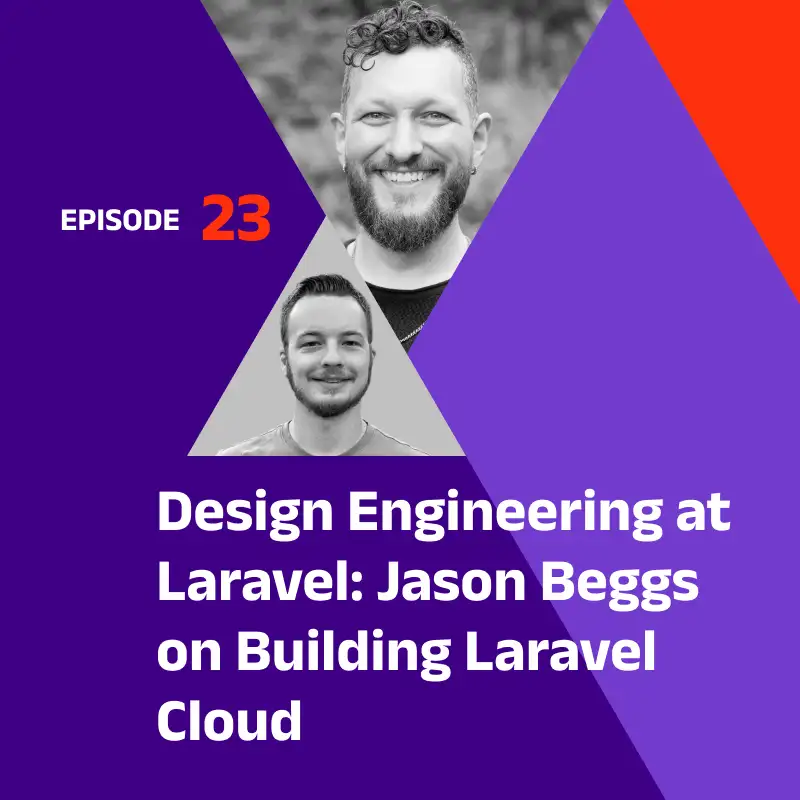
Design Engineering at Laravel: Jason Beggs on Building Laravel Cloud
The Laravel Podcast is brought to you by Tighten,
your friendly neighborhood Laravel experts.
Check us out at tighten.com
and also by other sponsors you will hear about later in the episode.
All right, welcome back to Laravel Podcast Season 7.
I'm your host, Matt Stauffer, CEO of Tighten and in this season, I'm joined every episode
by a member of the Laravel team.
And today, I'm joined by my friend, Jason Beggs.
The Jason Beggs.
He is a real person.
He exists in real life.
He is a staff software engineer at Laravel.
Jason, could you say hi and share a little bit about what you do at Laravel?
Hey, yeah, I'm a staff software engineer at Laravel, primarily working on the cloud team.
uh I'm technically a full stack engineer, but I focus more on the front end and design
engineering side of things.
And that's definitely your reputation.
I don't know.
I told you your first question is going to be, but it's not going to be.
You pretty quickly, when you kind of came on this scene, became known as like a guy who
did tailwind conversions, right?
Like if you have a design, no matter what the design is, Jason's going to be the guy that
converts it.
Is that something you curated on purpose?
Did you always think of yourself as being more front end heavy or did it just kind of
happen?
It's kind of wild.
just kind of happened.
I think I recently wrote a blog post about like how I got started and everything.
And I went back and like actually pieced together the whole timeline through like Twitter
DMs and emails and all kinds of stuff.
But yeah, I think the first thing that I ended up working on like really publicly was the
Laravel News conversion.
oh I think Tailwind was Alpha.
Maybe later when we did that.
So was like super early.
So I did that.
I converted the existing design to Tailwind and then a few months later, I actually ended
up doing some Tailwind work for y'all.
And it kind of took off from there.
was kind of all an accident and yeah.
I love it.
It's a happy accident.
Yeah.
For those who know Jason, but not in person, you may be surprised to find that someone who
has an incredibly quick wit and has always got something very funny to say is also very
kind of peaceful, kind of quiet.
And of course, you you got like a slow Southern drawl, right?
So it's just so funny because it's like Eric, I'm used to Eric having the accent that he
has.
Right.
But I think that you have garnered the majority of your reputation for who you are by just
your presence on social media.
where it's always super quick and it's super funny.
And so it's so funny because we always think of like a New Yorker, New Englander type when
we're thinking like really quick humor.
And I'm like, I just love, I love the balance of the slow Southern accent and all kinds of
stuff together with how freaking brilliant you are.
So anyway, thank you for hanging out.
I'm just having a great time with this.
So as you know, one of the first questions that I asked at the beginning of the podcast
for everybody is what is your story of coming to Laravel look like?
And that doesn't have to start.
day one at Laravel and because you just wrote the blog post I think it's actually super
relevant.
If somebody didn't read that blog post can you kind of tell us like what was the story
that you were capped in it?
Yeah, so I kind of already told the beginning of it.
The gist of the blog post was like, I sent two email or one was a Twitter DM and one was
an email and those two opportunities kind of catapulted into my entire career.
So one of them was Eric from Laravel News.
He posted that he was looking for someone to convert the Laravel News site to Tailwind.
And I just like...
Off a whim, DMed him and like asked if he'd be interested in me doing it and that actually
ended up happening.
So that was one opportunity.
And then the other one was I was kind of looking for something new to do and I always
admired Tighten and the team that you built.
So I just kind of cold emailed you.
I forget it like just saying like if y'all were ever hiring that I'd be interested.
Yeah.
And I think
Y'all weren't really looking for anybody at the time, but like you emailed me back and we
got on a call just to kind of get to know each other.
And like less than a week from when I sent the first email, you emailed me back and it's
like, I got this opportunity.
Do you want to do a contract job?
So I did that for y'all.
And then from there, I don't know, it just kind of took off on Twitter and I kind of.
got a name for myself as like the tailwind guy, like you said.
And I think later that year I ended up doing, like Taylor just cold DM'd me on Twitter and
asked if I wanted to build a landing page for him.
I think it was the Vapor landing page.
So of course I did that and that ended up, I think I built, I don't know, like 15.
or more sites for Laravel.
Wow.
Over the course of probably three or four years.
And yeah, kind of, I built that relationship with Taylor just as like the Tailwind guy.
So then after they got funding, I was like the first guy he thought of when they needed
somebody to do front end on cloud.
So at the time they are like, I actually had talked to them about joining full time.
probably back in the spring of 2024.
But I was pretty happy in my freelance career at that point.
So it didn't really work out.
But later in the summer, think, maybe June, July, he emailed me and asked if I would be
interested in just doing like a month or two of contract work just to kind of get on
basically to Laracon where we announced Cloud.
ended up agreeing to that.
And by the end of like the month or whatever, I was having so much fun.
like they offered again, they tried to convince me to join full time and I accepted this
time.
So like right after Laracon, I think it was September 2nd or something, I joined full time
on the cloud team.
I don't know if you ever worked with Jameson Valenta at Tighten when you were here,
when you worked with us, but he was a guy, he was my first hire, I think, at Tighten, and
my first hire at the SAS that I built before Tighten, and it took me probably...
maybe over a year to convince him to not be a freelancer.
Cause he was just like, I have this freedom.
I have these things that I could do.
And I was like, yeah, but I'm going to give you stability and benefits.
But it took so long.
And I was just like, man, it's just so wild.
The idea that some people are like, look, I understand it's a job.
But like I've got my world set up here.
Like I've got everything I want.
Obviously you're not going to say on the Laravel podcast, you're coming to work with
Laravel.
I'm sure it's a wonderful job and everything that you hope for.
But it is fun to understand that even the dream, because for so many of us, the idea to
work at the mothership, that's the dream, right?
I work at Laravel, so it's so funny you're like, yeah, man, that takes some time to talk
me into it.
When you were freelancing, I want to note to people who are kind of looking at the story,
because I get messages like Jason sent me every week.
And I take some calls and I don't take some calls.
And of the calls I take, the vast majority of people never do any work with us.
There was no question in my mind when I Jason Beggs, I'm going to work with this guy.
Right?
Like I was just like, when's the next project?
That was what it was.
And clearly other people had the same experience interacting with you.
Do you have an understanding, do you have an idea of how you were presenting yourself
differently?
Because obviously I can speak to it, but I'm like, from your perspective, do you know why?
Do you know like, oh, this is what made me who I am or anything like that?
You know, my grandpa taught me this or my dad taught me that, or I've always tried to ABC.
You just sort of like, oh, no, I just showed up.
Uh, no, not really at all.
I don't know.
I don't really even see myself as like that likable of a person.
don't know.
I'm not that outgoing or anything.
So I don't, I really don't know.
I don't know.
You're certainly capable and kind.
You're friendly.
So like from an interpersonal perspective, yeah, you're not outgoing, but you're great to
interact with.
But there was something, there was something that made it very clear to me that like this
person works hard and knows what they're doing and is going to do a good job with it.
There's something about our conversation where I was just like, oh, I trust that I will be
taken care of and this person will make sure that like I've got it.
And so was, was, there was some combination of competence.
was like, he understands what's going on.
And there was some combination of character, like competence and character.
was just like, yeah.
He understands what's going on.
He's a kind and caring person and he's going to work hard to do the work I want and learn
what he needs to know.
Right.
So I'm just like, I guess it's just who you are, man.
Yeah, definitely try to embody those two attributes for sure.
I think they're very important.
I don't know exactly how you convey or how I convey them across like Skype.
think we use Skype as...
Yeah, mean, you know what?
If you try to be that kind of person, I think it just comes across.
So, yeah.
All right.
We're going to take a quick pause for an ad break and then we'll be right back.
So thank you so much for our sponsors.
Our first sponsor is Honey Badger.
Move fast and fix things with Honey Badger's intelligent error tracking and application
monitoring for Laravel.
It's everything you need to keep production healthy and users happy.
So get your free developer account at honeybadger.io.
And our second sponsor of the day is for MailTrap, modern email delivery for developers.
They make it simple to send transactional and promotional emails with native SDKs and API
and SMTP access.
4,000 emails per month in their free tier.
Security compliant and 24 seven support from real people, not just chat bots.
Check them out at MailTrap.io today.
Okay, so now that we've talked about how you got to Laravel, what I want to think about is
what were you doing at the beginning?
Because you mentioned that you did cloud up until, you know, that's probably not even a
year ago, right?
No, wait, two years ago.
Jeez, it's 20.
have.
Year and a half ago, so Laracon 2024.
The big contract work that you did was pushed out and you're like, you know what?
I'll take a job there.
Let's do it.
Have you just been doing front end on cloud every day since then?
Have there been specific sub projects you worked on?
Like what has work been like for you at Laravel?
It's like probably 95 % been on cloud.
It's been pretty consistent.
Like cloud's a massive project, as you can imagine.
They've been keeping me pretty busy there.
There've been a few small things like helping out with the laravel.com site here and
there.
And I think I did a little bit of work on the Forge site when they relaunched, things like
that.
But yeah, pretty much 95 % cloud every day, all day.
So I imagine part of what you're doing since you're the Tailwind guy is given a design,
you convert it.
both because I think that you're doing other work and also because I know that you've
worked close hand in hand with some of the designers.
You're not just being given a blank file, know, a Figma file and say, convert this.
You're working on components.
You're probably working on interactivity.
So what are some of the interesting things that you've worked on in cloud over the last
couple of years?
everything.
So yeah, like my day to day, like technically that's my job is like building designs and
making sure the front ends is nice as it can possibly be.
But like day to day that actually looks like pairing with designers and like going over
what they're working on, like giving feedback, all that kind of stuff.
Just like working very closely with designers and PMs and.
even the backend engineers, like working across the whole team to make sure like we're
building the best possible solution for each feature.
Kind of thinking through everything from a UI UX perspective and just making sure that
everything's as easy to use and polished.
Make sure we think through all the edge cases before we ever even write any code, ideally.
And then once it gets into code, I'm obviously trying to keep things as maintainable and
clean as possible.
Make sure we actually cover all those edge cases, make sure it matches the designs that we
came up with.
Oftentimes we run into additional edge cases once we're in there and kind of think a
little bit deeper.
So I'll work back and forth with designers to like, I hit this bug or like this edge case,
what should we do here?
and just kind of thinking through all the features from that kind of perspective.
When you are working with designers, you mentioned UI, UX.
Do you have any kind of formal training, or have you given yourself any informal training
in UI and UX perspectives?
And if not, are you showing up with a mindset where you're contributing towards like, hey,
I understand UX, or are you showing up just in the UX conversations around like, well, I'm
a user, so I can at least help you think about how a developer would approach this?
How formal is your UX opinion being brought?
You know what I mean?
Yeah, I don't have anything formal.
just from doing it for so long.
then like, especially since joining Laravel and working with the designers that are here
and have been here, I think I've gotten a lot better at it actually in the last year and a
half because we have a very close team and we kind of push each other a lot further than
we would alone, I think.
Yeah.
So like together we kind of...
I don't know how to put it, like combined, we all like kind of bounce ideas off each other
and push the boundaries.
And I think the experience on cloud is what it is because of that.
So I don't think I have anything like any formal training or anything, but.
But you're not just showing up as imaginary user, right?
You're not just saying, well, as a developer, this is all I can do is how I'd use it.
You're bringing like formed, you know, casually formed and not officially formed, but
formed ideas around what you actually look like.
So you're kind of getting to be a part of the design perspective.
Do the designers get to be a part of development?
Is it one of those like, I don't know if you saw the thing where Justin Jackson was
talking about the three way Spider-Man meme where the product developers and the designers
and the programmers are all kind of doing each other's jobs.
How much overlap is there for y'all?
Some of our designers do know how to code a little bit.
And actually, just before this call, I was on a call with two of the others that don't
know how to code.
And I was getting them set up with the Cloud repo locally so they can just start tinkering
in Cursor.
So I think over time, we're going to see that kind of merge.
And I think I'd like to help the designers do more of what I do.
At least from like a polished perspective, like they shouldn't need to come to us to
change a color or something like that.
yeah, I think back to the UX perspective, I think it definitely does help that I am like
the perfect user of cloud.
Like it makes it a lot easier to like when we're building things, I'm like, what would I
want out of this feature?
And that's basically what we build a lot of times.
Because I am, like our whole team pretty much is Laravel developers, so we know
exactly what we want and how it should work, which is super nice.
Yeah, and probably if you're using cloud on your own projects and you get annoyed by
something, you're probably the first person to come and say, hey, if I'm annoyed by this,
everybody's going to be annoyed by this.
Let's fix it.
Yeah.
Love dog fooding.
from the front end perspective, you mentioned that kind of you're like doing those
conversions.
Are you doing interactivity in JavaScript or are you just doing templates?
No, everything.
So our cloud's built in React, which pretty much none of us really knew at the start.
Yeah.
And I wasn't a huge fan of it.
I'm still not technically the hugest fan of React, but yeah, we build everything.
I build CSS, React, all of it.
If you were to build a side project today, what would your JavaScript framework be?
ah That's tough.
Before I joined Laravel, I was more of a TALL stack guy.
That's why.
It's because with freelance and oftentimes you're just trying to build stuff as fast as
possible.
And that's an extremely productive stack.
But the more JavaScript heavy ah front ends are like very powerful, I guess.
And you're able, you have a lot more control.
to do some really fancy, like, polished stuff like we did in Cloud.
So I think it would kind of depend on what the side project is and what I'm going for.
But I don't know.
Things have changed a lot on the Livewire side, too, with Flux now.
So you can kind of create a lot of that polished stuff on the Livewire side as well.
So I don't really know.
It depends?
Yeah, it would depend.
If you had to do React though, sounds like it might not be your favorite, but you could
survive.
Yeah, I wrote another blog post a few months ago called, I think, Embrace the Tools You
Use or something.
Yep.
It's basically like, sometimes you don't get to choose the tools that are ideal or like
fit your personal opinions the best.
But if you're going to have to work with them, you might as well like embrace them and
like get good at them.
So like with React, it's like not my favorite, but I've spent a lot of time in the past
year and a half.
like actually understanding best practices and the best ways to use it.
If somebody else finds ourselves in that same situation with React specifically, are there
any resources that you really enjoyed using to learn it better?
Yeah, they actually have some really good articles in their docs around like you might not
use, I think one of them is called, you might not need an effect.
Use effects are like one of the weirdest concepts in React, think.
And it's probably like the biggest foot gun that you can, like especially with AI, like
you'll litter use effects everywhere and they can really start to shoot you in the foot.
Definitely recommend reading that article.
And then I think I took Kent C. Dodds' course, Epic React, I think it's called.
It was really good and covered everything from the basics all the way to really advanced
stuff.
So that was really helpful as well.
Amazing.
So our third sponsor of the day is Thunk.
After years of losing time and money to scheduling chaos, chasing invoices and client
communication gaps, the team at Thunk built Tidy.
So you don't have to risk your business learning the same lessons.
Check it out at tidyup.agency.
And finally, Laravel, I keep wanting to say Laravel LLC, because that's what it's been for
so long.
Laravel Holdings, Laracon US and Laravel Cloud.
So Laravel Cloud is the fastest way to deploy Laravel apps.
And it also solves all sorts of common problems that keep web artisans from shipping.
And Laracon US is the premier in-person event for all web artisans to come be with your
people, level up, and leave ready to ship faster and better than ever.
Check out those at cloud.laravel.com and laracon.us.
And as Dave mentioned in the last episode, I will be speaking this year at Laracon, so you
gotta come hang out.
We gotta say hello, do a little fist bump, hear my talk.
I look forward to seeing you all there.
Okay, so back from sponsors.
I am curious what...
Are you not just working on right now, but also what are you learning?
Let's talk about what you're working on in a second.
What are you learning?
Like what are you doing your free time right now?
Are you all in the AI train trying to get your Claude workflows?
Are there particular technologies that you're really interested in?
Like what are you nerding out about right now?
Yeah, I would say probably my free time is not a lot.
I'm experimenting with different ways of using AI.
Day to day, I'm kind of just using Claude cursor, OpenCode to help me work.
Definitely not AI maxing.
Some people run 20 different Claudes at the same time.
But I use it for day to day stuff.
But stuff like building Figma is
designs, like really polished designs.
It's not great at, so I'm still trying to kind of figure out some good workflows for that
kind of thing.
But yeah, everything's all about AI now.
Like every moment we get, we got to be tinkering.
Yeah, and that was going to be one of my next questions was, you know, what's your day to
day interaction with AI?
So you mentioned cursor, OpenCode, Claude.
You mentioned that it's not really great at fully building the thing out.
Have you found that there are any particular pieces of your workflow where you're like, I
wouldn't touch AI for this or this is the one thing I was really good at?
Yeah, I've done a lot of big refactors since like November, December when Opus 4.5 came
out.
So like when we first started Cloud, like we didn't really know React.
So we had some kind of bad practices in there and we were moving like blazing fast.
So there was no time to slow down and refactor things.
And we built up some tech debt basically.
I've used AI to do some pretty heavy refactors over time.
And it works really good at that, like taking the pattern you have, changing it to
something else across 80 different files.
It's great at that.
Yeah.
Do you guys have a lot of test coverage on the JavaScript side?
Almost none.
Yeah, it's especially when it's very visual JavaScript.
Like we're not talking about a lot of data manipulation JavaScript, right?
It's very visual.
ah Man, it's rough.
So you're finding it's pretty decent at those refactors even when it doesn't have tests to
check against or you're like, no, we have to do really heavy manual testing afterwards.
Yeah, depending on what it is, I'm definitely doing a lot of testing QA, which I think
that regardless of what you're working on with AI, like that's a very important thing.
With back end code, it's a lot easier because we do have like really good test coverage.
So the test pass, you can be pretty confident that it's working.
The front end, I've never really had that much confidence.
I've always done quite a bit of QA on the front end just to make sure things are still
pixel perfect after doing refactors.
Speaking of testing, I was curious, because I started as a more front-end focused, well,
that's not true.
I started doing PHP in the late 90s, paused, went to school, worked for nonprofit, just a
lot of WordPress and expression engine type stuff.
And I came back, I came back largely as a front-end developer.
was doing responsive design right when it first came out, and a lot of very complicated
vanilla JavaScript at the time.
And QA was...
a lot of work across the different browsers.
We were just spending so much time, you know, I'm trying to remember the tool we use, but
there's one tool we use where it would spin up like a little micro version of the browser
and all these different browsers and all these different operating systems so that you
could get screenshots of what the app looks like.
And then once the need to test the interactivity is even worse, do you have to deal with a
lot of that day to day?
Like, do you have a Android device and an iOS device that you're testing everything on?
Like, what does your QA life look like?
Yeah, 99 % of the time I'm in Chrome and most things just work.
Occasionally, Dave Hicking or Florian will send me a message like, this is broken in
Safari.
think Safari is the new IE 6.
Pretty much most things just work.
Right now, I'm actually working on making the whole app responsive.
We were moving so fast in the beginning that we made the hard decision that we're not
going to support mobile.
Sizes basically so yeah until now we haven't really dealt with mobile at all But right now
I do have like an actual Android and iPhone sitting here that I'm testing Just to make
sure at least the first pass that both devices work pretty well But yeah day to day I'm
usually in Chrome if it works in Chrome it probably works in Safari and Firefox as well
Brave and all that, Okay, so if you are working on your site locally and you want it to
work on your devices, which I assume in the same Wi-Fi, what tool is your preferred tool
for getting them onto that device?
Exposed to the word.
Yeah, I love it.
Expose is a tool from Beyond Code who's made by community members, Laravel community
members, and it's like ngrok, but it basically shares your local version out to a public
endpoint that you can visit somewhere else.
So there are some tools that will work only if you're in the same Wi-Fi, but that one
would work anywhere, right?
You could send that link to anybody on the internet.
The nice thing about that is like Friday I spun it up and sent the link to our designers
and PM that's on the mobile project with me and they were able to open it up and kind of
click around and find some issues and send them to me so yeah, it works great.
Okay, so I have talked a lot about work and technology, but you are a whole human being
and you have other interests and one of which I'm Familiar with because I'm jealous of all
your woodworking carpentry building skills, but I'm just curious What do you do in your
free time?
I mean you've got a family, you know, you've got hobbies what you know on a Friday
Saturday afternoon, maybe let's say what are you doing?
What are you up to?
Yeah, so yeah, I do woodwork, try to spend a lot of time with family.
We have an orchard now, some cows.
You have cows?
Yeah.
What?
I have like seven cows, I think.
Okay, so are the cows for milk?
Are they for meat eventually?
What are you doing with them?
Both.
We got a breed that's good for both.
We've yet to get anywhere with anything, but.
Are you out milking the cows at 5.30 every morning?
Eventually, is that going to be your life or?
My sister-in-law that lives right across the road, she's like super into homesteading.
They have all kinds of animals and stuff.
the cows are over there with them, but I kind of leave them to her and my wife.
They can deal with it.
Wow.
I'll go visit every now and then and reap the rewards one day.
But yeah.
Okay.
And with your house, I mean, I would see pictures of your house as you're building it.
So what's your involvement in building something as large as your house or your office?
I'm assuming you're in the office that you built too right now.
Yeah.
So can you kind of, for those who aren't familiar, can you talk a little bit about what
you do there?
Yeah, so our house, we pretty much built it.
Well, I built a lot of it myself.
Yeah.
Like I helped with all the framing, the actually clearing trees, that kind of stuff.
Framing, installing windows.
I did all the trim.
I built cabinets, lot of different furniture across the house.
Built out this office.
Yeah.
We did a lot of the work ourselves just to save money and it was fun.
And that was when I was freelancing.
So yeah, I basically worked like 20 hours a week the whole time we were building and
worked on the house, probably 40 hours a week, nonstop.
Is it done?
uh
we still have a lot of projects we want to get done, but it's pretty done.
The latest project I did was the stairs.
It took me three or four months, I think total just off and on, which it was the most
ambitious project I've done by far.
Very difficult with the design that I chose.
Okay.
And it really pushed my skills to the max.
It was above my skill level.
So I had to like.
really try hard to get it right.
Yeah, for sure.
Are you self taught and all that stuff?
Yeah, pretty much.
think in 2020, I was bored and I don't know how I started watching woodworking YouTube
videos, but I got into watching them and then bought a table saw and a few tools and ended
up building a few small things that ended up leading me to bigger things.
And then somehow I built a house all of a sudden.
Didn't you build the house just like a couple years after that?
When did it start?
Was it 23, 24?
We moved in at the end of 2023, I think.
So you got into woodworking in 2020 and you started building your house maybe two years
later?
Yeah.
It's crazy.
And that's what I'm saying, I'm like, that's the type of person you are, that's why you
get in a call with someone and they're like, yeah, I want that guy to work with me.
I guess so.
It's kind of interesting though, like with all the different projects in the house, like
the furniture and stuff, you can like see my skill level progress throughout.
The first things I built were, was like a night, a nightstand and it was all right.
Like for like a first project goes pretty good, but then I like built a copy of it and
that one's nicer than the first one.
And then I built the bed, like a platform bed with drawers.
in the same kind of style.
That was nicer than the nightstand.
then like for the house, the kitchen cabinets are quite a bit nicer than that.
It just keeps going up.
Does it drive you nuts to see the original stuff or are you proud of it?
I'm still proud of it, especially considering like that I was basically starting from
nothing.
Like, nobody taught me any of this pretty much.
was just figuring it out as I went.
So yeah, it's cool, I think.
I've only built one thing for Inside the House and it was very clearly made by somebody
who doesn't know how to work with Inside the House stuff.
I built all sorts of stuff for the yard and it fits fine in the yard, but Inside the
House, I'm like, that's a very different level of finesse and materials and finish and
everything like that.
Yeah, and I mean, none of my stuff is perfect.
Like, there are definitely things I would do better now that I, like on the kitchen
cabinets, I'm better even now than I was when I built those.
So I would do things differently if I did it again, but I don't know.
It's kind of cool just to see the progression.
Love it.
OK, so back to work.
We've caught up to today.
You've been working on cloud.
You develop these workflows with the designers.
You do some UX work as well.
You've got your AI kind of workflow.
What are you working on right now?
Or what are you working on going forward?
Yeah.
So responsiveness will be a big one.
I hopefully we're launching that in the next week or two, at least the first pass.
Nice.
So we'll get everything working on mobile and then we have a ton of different things
coming up for cloud.
A lot of it I probably shouldn't talk about yet, but.
that's exciting.
Cool.
Well, this will come out on, I think on the 28th.
So hopefully by the time this comes out, your responsiveness will have launched.
do you think by then we'll have any of the cloud stuff started trickling in or is this
more down the road kind of stuff?
Probably a month or two out at least before the big stuff comes.
We'll have to keep our eyes open.
Yeah, that's awesome.
Oh, I love a secret.
Even if I don't know it, I just love knowing it's there and I have something to look
forward to in a couple of months.
Yeah.
OK.
Is there anything that you hope we were going to talk about today that we didn't get a
chance to cover?
I can't think of anything.
I think we've covered everything.
Yeah.
Well, I told you at the beginning, I was like, you're not a big talker, you're not one of
those persons I'm going to ask a question, you're to talk for 20 minutes.
So I appreciate you even hanging out here and talking for so long, sharing all this kind
of stuff.
And you know I appreciate you because you are a great guy doing amazing work for the
community.
So thank you so much for coming to hang out for a bit.
Yeah, I've enjoyed it and thank you for all you've done for me in the past, whatever, six
years.
It's been great.
Happy to my friend.
I love it.
Well, for the rest of you, we will see you all next time.
Creators and Guests